| Best for | Simple wallet-to-wallet swap flow, No conventional trading account needed, Useful for small convenience conversions, Avoids holding a long-term platform balance |
|---|---|
| Not for | Limited public fee transparency, Thinner track record than major competitors, Less independently verifiable operational detail, Not appropriate for large or urgent transfers |
| Criterion | Score | Note |
|---|---|---|
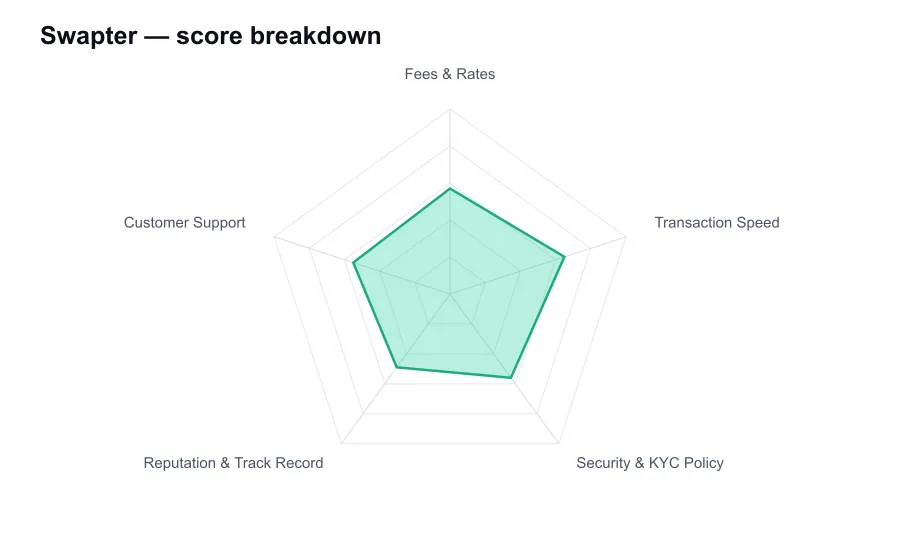
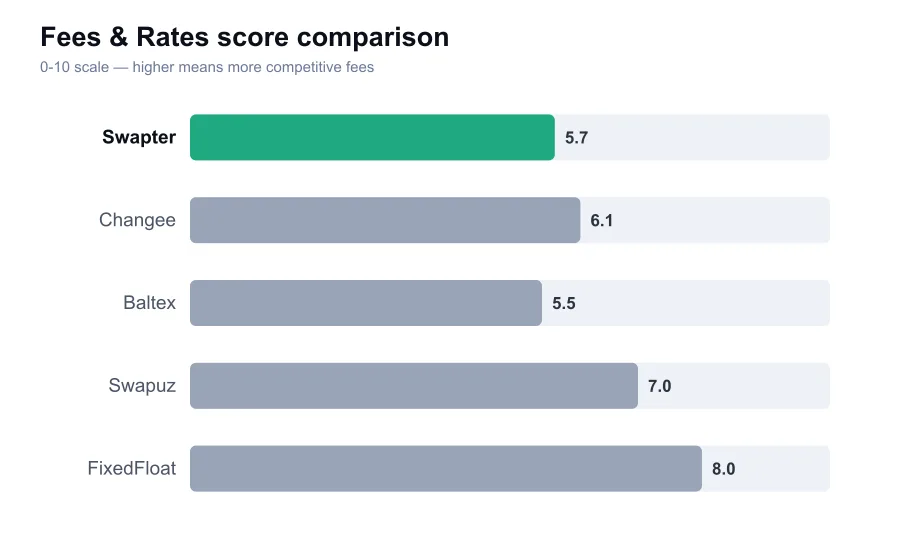
| Fees & Rates | 5.7 | Quote-based cost with limited public fee detail |
| Transaction Speed | 6.5 | Network and liquidity route determine completion time |
| Security & KYC Policy | 5.6 | No standing balance, but limited public transparency |
| Reputation & Track Record | 4.9 | Smaller public footprint than established rivals |
| Customer Support | 5.5 | Use records and a test swap before relying on support |
What is Swapter?
How Swapter Works
- Choose the cryptocurrency pair and amount
- Enter the destination wallet address
- Review the displayed exchange quote
- Send the deposit asset to the generated address
- Track the swap and confirm receipt in your wallet
KYC
| Requirement | optional |
|---|---|
| Notes | The normal service flow is account-light, but users should assume that AML or compliance checks may require additional information if a transaction is flagged. |
How to Use Swapter Safely
- Verify that you are on the genuine Swapter domain
- Compare the final output quote with established alternatives
- Test an unfamiliar route with a small amount
- Match the token and network exactly
- Keep the order ID, quote screenshot, and transaction hash
- Avoid using a small provider for deadline-critical transfers
Review Summary
Swapter is a smaller instant crypto exchange service that presents itself as a quick route between digital assets without the account-heavy structure of a conventional centralised exchange. Its basic flow will be familiar to anyone who has used an instant swap provider: choose a pair, enter a recipient address, send the deposit, and wait for the converted asset. That model can be useful, particularly for a simple wallet-to-wallet conversion. Swapter's problem is not that the concept is unusual. It is that the company has a far thinner public record than established names such as SimpleSwap or StealthEX.
That difference should shape how a careful user approaches it. A smaller provider can deliver a perfectly good exchange, and lack of mass-market fame does not prove bad conduct. But crypto users have seen too many short-lived services, cloned websites, and opaque aggregators to give a new or lightly documented brand automatic trust. With Swapter, the sensible position is cautious use rather than blanket rejection. Verify the domain, inspect the quote, start small, and don't make it the only route for funds that have a strict deadline.
The service operates as an instant exchanger rather than a trading platform. There is no public order book to examine, no visible bid and ask depth, and no detailed control over execution. Swapter provides a conversion quote and handles the route after the user funds the order. This keeps the experience simple. It also means users cannot separate the provider's margin from the underlying market price in the way they can on a spot exchange. The final output shown before sending is what should be compared, not any vague promise of low fees.
Swapter's public fee disclosure is less developed than I would like. I would not assign a precise flat percentage because the effective cost depends on the pair, liquidity source, and network conditions. Like other instant exchangers, it can build costs into its exchange quote. That may be acceptable for a small convenience trade, but it creates a disadvantage for a price-sensitive user. A transparent exchange publishes maker and taker rates, while an aggregator quote leaves the user to infer the spread by comparing it with the market.
The practical response is easy: do the comparison yourself. Open Swapter alongside StealthEX, SimpleSwap, and a major exchange or DEX where the pair is liquid. Enter the same amount and compare the final receive estimate after network fees. If Swapter is meaningfully worse, there is no reason to reward opacity. If it is competitive and the amount is modest, its streamlined process may be enough. This is a category where brand loyalty is rarely rational because providers can source liquidity from overlapping pools.
Speed is also route-dependent. A transfer over a fast chain can move through the process quickly once the deposit is recognised. Bitcoin, Ethereum during congestion, and assets with higher confirmation requirements naturally take longer. A smaller instant exchanger has an additional concern: less visibility into its partner infrastructure. If a route stalls, the user may not know whether the delay comes from the blockchain, Swapter's own system, or an upstream liquidity provider. That lack of diagnostic detail is inconvenient, especially when a swap is time-sensitive.
Swapter's account-light format is appealing to users who do not want to create another username, password, and stored personal profile. It is better understood as a no-registration default than as a promise of anonymity. Financial crime controls are common throughout the industry, and any service handling swaps can pause or investigate a transfer that triggers risk systems. If Swapter applies KYC or AML procedures, a flagged user may be asked to provide documents. A person who cannot accept that possibility should avoid commercial conversion services with discretionary compliance controls.
The security benefit of this format is limited but real. Swapter is not meant to hold a permanent customer balance, so users can keep funds in their own wallets before and after an exchange. That is safer than leaving an idle balance on a lightly known platform. During the swap itself, though, the deposit is under the service's operational control. There is no blockchain magic that makes this trustless. Users are trusting a company, its wallet management, its code, and its partners to settle the trade correctly.
Public transparency is the weakest part of the Swapter proposition. There is less independently verifiable corporate history, regulatory detail, and public operational disclosure than at larger platforms. That does not automatically make the service unsafe, but it limits the evidence a reviewer can use to grant confidence. I would be much more comfortable using a well-documented, long-running provider for a large conversion. Swapter has not earned the same margin of trust simply by offering an interface that resembles competitors.
Reputation should be judged proportionately. A service with fewer years of visible history and fewer established integrations should receive a lower reputation score than SimpleSwap or StealthEX, even if individual orders work smoothly. Crypto is full of products that appear credible until a stressful event exposes thin support, weak reserves, or an unclear legal entity. Swapter may work fine as a small-swap utility. The absence of broad, durable evidence is the reason to keep exposure limited, not a claim that every user will encounter a problem.
Support is another area where smaller providers face a hard test. Basic website contact tools can handle common questions, but the meaningful issue is what happens after a deposit is delayed, underpaid, sent with a missing tag, or flagged for review. A large, established provider has more public evidence of how it handles such cases, even if the answers are not always satisfactory. With Swapter, I would preserve every detail before contacting support: the order ID, receiving address, deposit address, transaction hash, time sent, and screenshots of the original quote.
The provider can be useful for people who know exactly what they are doing. Someone moving a small amount between two wallet assets, who has checked the rate and does not mind accepting execution risk, may find the no-friction flow convenient. It is a poor fit for a beginner who might confuse token networks, for a business paying a deadline-sensitive invoice, or for anyone swapping funds that cannot be delayed. The smaller the public footprint, the more the user should favour test transactions and independent quote checks.
There is also a basic technical issue that applies heavily to Swapter's target audience. Token names do not guarantee compatibility. USDT, USDC, ETH variants, and wrapped coins can exist on several networks. A receiving wallet must support the exact asset and chain selected in the order. A wrong-network deposit can be difficult or impossible to recover, and a wrong output address can be final. Instant exchange interfaces can make these steps feel routine, but users should slow down precisely here.
My take is restrained. Swapter may be serviceable as a low-value convenience route, but it has not earned the trust premium that comes with a lengthy public track record and clearer disclosure. I would not call it a first-choice provider for material amounts. The lack of an account requirement is handy, and wallet-to-wallet swaps are useful, yet those benefits are available from better-established competitors. If you use it, compare the quote, send a test amount, and avoid treating a simple web flow as evidence of institutional-grade reliability.
Pros & Cons
| Pros | Cons |
|---|---|
| Simple wallet-to-wallet swap flow | — |
| No conventional trading account needed | — |
| Useful for small convenience conversions | — |
| Avoids holding a long-term platform balance | — |
Frequently Asked Questions
Is Swapter a normal crypto trading exchange?
No. Swapter is an instant exchange service, not an order-book venue. It presents a conversion route for a specific pair rather than letting users place market or limit orders.
Does Swapter have a published flat trading fee?
Swapter's effective cost is best assessed through the final quote for a pair. I would not rely on a universal percentage because spread, liquidity, and network costs can vary.
Should I use Swapter for a large crypto swap?
I would not use a lightly documented instant exchanger as the first route for a large amount. Test a small order first and compare established providers and spot-market alternatives.
Why might a Swapter order take longer than expected?
The deposit must receive blockchain confirmations, then the conversion route must settle. Bitcoin confirmations, congested networks, liquidity issues, or review procedures can increase the wait.
Can I send USDT on a different network than the Swapter order shows?
No. You must send the exact token and network requested by the order. USDT on Tron, Ethereum, and other chains are operationally distinct and a mismatch may be unrecoverable.
What records should I keep for a Swapter swap?
Keep the order ID, deposit address, receiving address, transaction hash, amount, time sent, and a screenshot of the original quote. These are essential if support needs to trace an order.