| Best for | Simple wallet-to-wallet swap flow, No standing custodial account balance, Useful for small, straightforward conversions, Order tracking is available |
|---|---|
| Not for | Limited independently verifiable operating history, Quote spread is harder to audit than spot trading, Large transfers carry meaningful counterparty risk |
| Criterion | Score | Note |
|---|---|---|
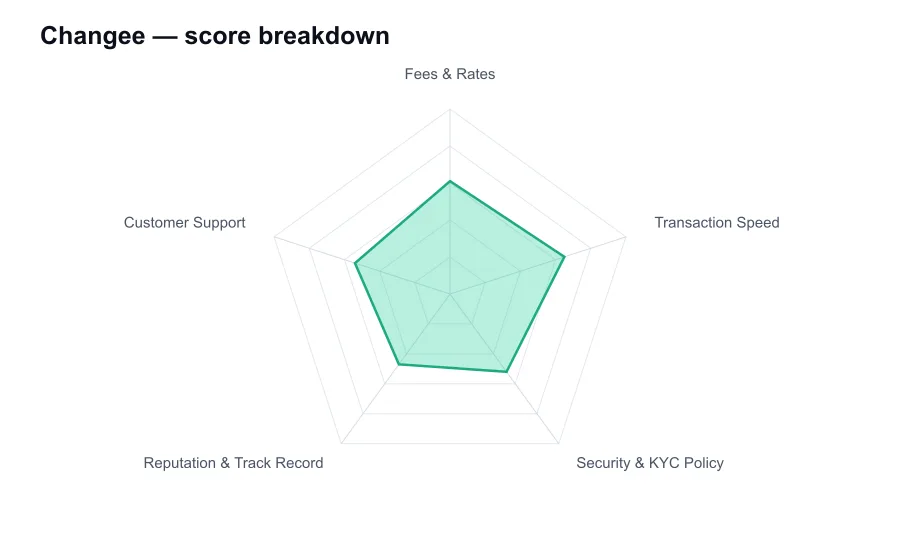
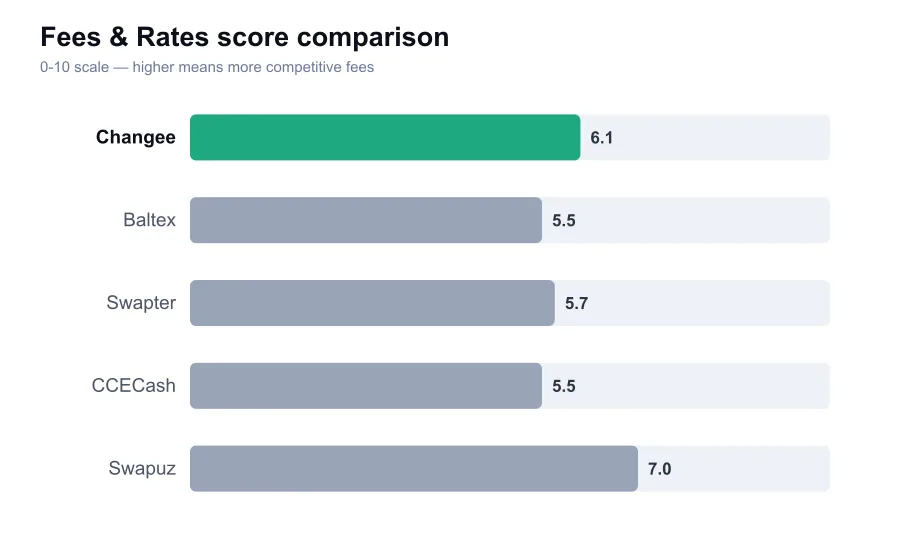
| Fees & Rates | 6.1 | Quotes can be competitive, but the spread needs comparison. |
| Transaction Speed | 6.5 | Fast for routine swaps after blockchain confirmations. |
| Security & KYC Policy | 5.2 | No routine account sign-up, but limited public transparency. |
| Reputation & Track Record | 4.7 | A much smaller public track record than leading rivals. |
| Customer Support | 5.4 | Order tracking helps, though public support evidence is limited. |
| Fact | Value |
|---|---|
| Service type | Instant cryptocurrency exchange |
| Account model | Wallet-to-wallet swap flow |
| Rate models | Quote-dependent floating or fixed rates |
| Custody model | Funds sent to order deposit address |
| Order tracking | Exchange ID and blockchain transaction hash |
What is Changee?
How Changee Works
- Select the asset pair and enter the amount
- Provide the receiving wallet address
- Review the displayed rate and expected output
- Send the deposit to the generated address
- Track confirmations and payout with the order details
KYC
| Requirement | optional |
|---|---|
| Notes | Routine account creation is not central to the swap flow. Identity information may still be requested if a transaction is flagged by compliance screening. |
How to Use Changee Safely
- Run a small test swap before sending a large amount
- Match the token and network at both ends exactly
- Save the exchange ID and deposit transaction hash
- Compare the final expected output with competing quotes
- Do not reuse an old deposit address without instructions
Review Summary
Changee is a small instant cryptocurrency exchange built for one job, swapping one asset for another without opening a trading account. It belongs in the same broad category as ChangeNOW, SimpleSwap, Changelly and ChangeHero, though it is a far less established name than those services. The appeal is obvious: choose a pair, provide a receiving address, send the deposit, and wait for the output. There is no order book to read and no trading terminal to master.
That simplicity is useful for someone who already holds crypto in a self-custody wallet and wants to move between assets quickly. It is much less compelling for a buyer making a first crypto purchase, an active trader seeking tight execution, or anyone who needs a highly documented compliance process. Changee presents itself as a conversion service rather than a full exchange, and users should judge it by that narrower standard.
The first issue is price discovery. Instant exchangers commonly quote either a floating rate or a fixed rate. A floating quote can change while the deposit is travelling through the network, particularly on Bitcoin or Ethereum during a busy period. A fixed quote gives more certainty, though the provider normally builds a larger buffer into it. Changee's rate screen should be treated as the source of truth for each transaction, because a single headline fee tells only part of the story.
That is where smaller swap services can disappoint. A quote may look competitive until a user compares the expected output against a liquid spot market and accounts for network costs. The difference includes the provider's spread, liquidity-provider costs, and the blockchain fee. Changee does not have the public fee documentation and extensive execution record that make it easy to audit those components. I would never send a large amount through it without first running a small test exchange.
For modest swaps, the service can still be practical. The absence of a conventional trading account removes some friction, and a quoted conversion amount is easier to understand than a complex maker and taker schedule. But people who swap regularly will usually find better value by comparing several services immediately before confirming. Even a seemingly small difference in rate matters once the transaction reaches four figures.
Speed depends on two separate things that users often confuse. Changee can process an order promptly after it receives the required confirmations, but it cannot make the source chain confirm faster. Bitcoin deposits may take considerably longer than deposits on a fast network. Ethereum transactions can also be delayed by low gas settings. Once funds are confirmed, an instant exchange still has to source and send the destination asset.
For common pairs with accessible liquidity, the expected path is generally measured in minutes rather than days. That does not mean every order will finish in minutes. Less liquid tokens, wallet maintenance, chain congestion, an incorrect memo, or a compliance check can turn a simple exchange into a support case. This is a familiar weakness of the instant-exchange model, and a smaller provider has less margin for operational error than a major venue.
Changee's non-custodial positioning deserves a careful reading. It does not mean the service never controls funds. Users send coins to a deposit address operated for the exchange process, and the provider or its liquidity partner controls those funds until the swap is completed. The important distinction is that Changee does not ask customers to maintain a standing balance in a hosted trading account. That reduces one category of risk, but it does not eliminate counterparty risk during an open order.
The service can be used without routine account verification for ordinary transactions, which is convenient and fairly typical for this type of product. It should not be read as a promise that identification will never be requested. Anti-money-laundering screening can flag an address or transaction pattern, after which a provider may ask for documents or additional information. Anyone who cannot tolerate that possibility should not use an instant exchanger for funds that need immediate access.
Security information is where Changee feels thin beside the strongest alternatives. A serious customer should look for a clear legal entity, detailed terms, transparent compliance policy, reliable incident communication, and a support path that works during a dispute. A clean web interface is not evidence of those things. Changee has a limited public profile, so there is less independent material available to test its claims and fewer long-running user records from which to judge how it handles difficult cases.
That limited record affects the reputation score more than the usability score. I have not seen enough public evidence to describe Changee as a proven long-term operator in the way I would describe ChangeNOW or Changelly. Lack of famous complaints is not the same as a strong record, especially for a relatively obscure service. For a small conversion, that may be an acceptable trade. For savings, treasury transfers, or a time-sensitive payment, it is not.
Support is another area where scale matters. A transaction ID and a responsive support channel are essential if a transfer has been sent with the wrong network, a delayed confirmation, or a missing destination tag. Changee provides order tracking, which is useful, but customers should preserve the deposit transaction hash, the exchange ID, the quoted amount, and screenshots before asking for help. Those details make a support request much easier to resolve.
The sensible way to use Changee is cautiously. Confirm the exact network at both ends, do not send an unsupported token variant, and test the service with an amount you can afford to have delayed. Avoid using a deposit address after an order has completed unless the instructions expressly say it can be reused. Instant-exchange addresses are often order-specific, and a mistake can create an unpleasant recovery process.
My view is that Changee is a usable convenience tool, not a provider that has earned blind trust. It may suit someone making a small, uncomplicated wallet-to-wallet conversion who has checked the quote against rivals. It does not have enough public operating history or transparency for me to recommend it for large transfers. If the amount matters, choose the service with the better documented support record, even if the initial quote is slightly less attractive.
Pros & Cons
| Pros | Cons |
|---|---|
| Simple wallet-to-wallet swap flow | — |
| No standing custodial account balance | — |
| Useful for small, straightforward conversions | — |
| Order tracking is available | — |
Frequently Asked Questions
Does Changee require an account before swapping?
Its instant-swap flow is designed for wallet-to-wallet exchanges rather than a conventional trading account. Keep the exchange ID and deposit transaction hash until the order is complete.
Can a Changee swap be delayed after I send funds?
Yes. The deposit must receive the required blockchain confirmations, then the provider must complete the payout. Network congestion, low-liquidity assets, or transaction screening can add time.
Why can the received amount differ from the first quote?
A floating-rate order can move while the deposit confirms. The final amount also reflects the provider's spread, liquidity costs, and the destination network fee.
Should I reuse a previous Changee deposit address?
No, unless the current order instructions explicitly permit it. Instant-exchange deposit addresses are commonly generated for a particular order, and reuse can complicate recovery.
Can Changee ask for identity documents?
Yes. A no-routine-sign-up service can still request information if automated anti-money-laundering checks flag a transaction or address.
What should I save if my order needs support?
Save the order or exchange ID, source transaction hash, sending amount, receiving address, and screenshots of the quote. Those items establish what was sent and what was expected.