| Best for | No standing custodial account required, Fixed-rate and floating-rate quote options, Simple wallet-to-wallet exchange flow, Useful selection of major coins and stablecoins |
|---|---|
| Not for | Final pricing includes variable spread, AML checks can interrupt a no-registration swap, Less transparent than major regulated exchanges, Large transfers deserve a test transaction first |
| Criterion | Score | Note |
|---|---|---|
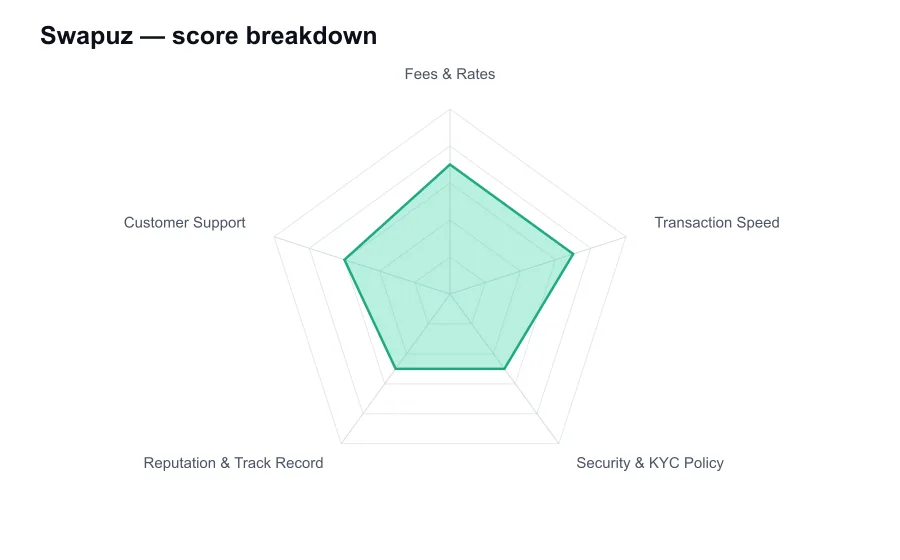
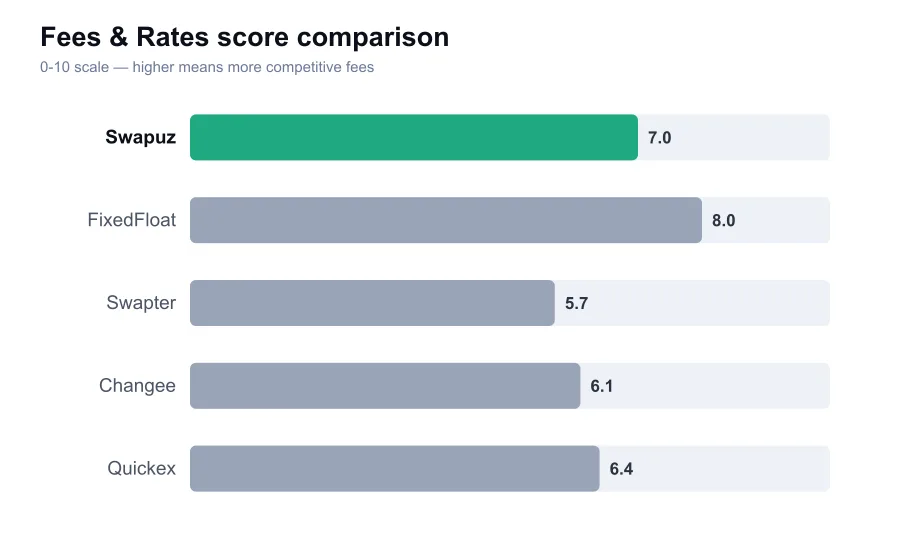
| Fees & Rates | 7.0 | Competitive quotes, but spreads vary by pair and network |
| Transaction Speed | 7.0 | Fast on liquid chains, confirmation delays still apply |
| Security & KYC Policy | 5.0 | Non-custodial flow, with possible AML review |
| Reputation & Track Record | 5.0 | Established online service, limited public corporate detail |
| Customer Support | 6.0 | Site support can trace orders, escalation is limited |
| Fact | Value |
|---|---|
| Exchange model | Non-custodial instant exchange |
| Rate options | Fixed and floating rates |
| Account model | No routine account required |
| Settlement | Direct payout to a wallet |
| KYC policy | May be requested for risk review |
What is Swapuz?
How Swapuz Works
- Choose the crypto pair and the rate type
- Enter the destination wallet address
- Review the quoted payout and network
- Send the exact deposit amount to the generated address
- Track confirmations and receive the converted asset
KYC
| Requirement | optional |
|---|---|
| Notes | A routine account signup is generally not part of the exchange flow. Swapuz may request identity or transaction information when compliance screening flags an order. |
Supported Assets
| Notable coins | Bitcoin, Ethereum, Tether, USD Coin, Solana, Litecoin, BNB |
|---|---|
| Networks | Bitcoin, Ethereum, Tron, Solana, BNB Smart Chain |
How to Use Swapuz Safely
- Compare the final payout with at least one competing quote
- Verify the token network at both the sending and receiving wallet
- Test a new route with a small amount first
- Save the order ID and deposit transaction hash
- Use a wallet address copied from your own trusted wallet
Review Summary
Swapuz is a non-custodial instant crypto exchange service aimed at people who want to convert one asset into another without opening a conventional exchange account. It sits in the same broad category as ChangeNOW, SimpleSwap, LetsExchange and Changelly, although Swapuz has tried to distinguish itself through a simple interface, a large advertised asset list and relatively aggressive rate comparisons. The core appeal is obvious. Pick a pair, enter a receiving address, send the deposit, and wait for the swap to settle. That convenience is real, but it doesn't remove the usual risks attached to lightly regulated swap intermediaries.
The service offers both floating-rate and fixed-rate exchanges. That distinction matters more than the promotional language around it. A floating swap is usually cheaper at the moment you create it, but the final amount can move if the market shifts while the provider receives, confirms and converts your deposit. A fixed-rate quote gives you more certainty, though the provider builds a spread into that certainty. For a small Bitcoin to USDT conversion during calm markets, floating can be sensible. For a larger transfer, or a volatile asset such as SOL, fixed rate is generally the safer choice.
Swapuz does not behave like a traditional order-book exchange. You are not placing a visible trade against another user, and you are not funding a reusable account with a stated maker or taker schedule. The price shown includes the service's routing economics, liquidity-provider pricing, network costs and spread. That makes its fee presentation less transparent than an exchange such as Kraken, where trading fees are published in advance. It is also normal for the instant-exchange sector, so Swapuz is not uniquely opaque. Still, users should compare the exact output against at least one competitor before sending.
In practical use, Swapuz can deliver decent value on common pairs, particularly major assets with deep external liquidity. BTC, ETH, USDT, USDC, SOL and LTC tend to produce the most competitive quotes because providers have plenty of routes for them. Smaller tokens are another matter. A wide advertised catalogue is useful only if a pair has dependable liquidity and a sensible network route. The quote for a thin token can include a painful spread that is far bigger than any visible service charge. Don't assume that a low-looking headline rate means the transaction is cheap.
Network fees are the other part of the bill people frequently underestimate. A Bitcoin swap can look reasonable until a busy mempool makes the deposit confirmation slow and the network charge high. Ethereum mainnet can be even worse for smaller conversions. Where the asset exists on several chains, such as USDT or USDC, choosing the right network can make a major difference. The cheapest route is often Tron, but only if the receiving wallet supports TRC20. Sending an asset on the wrong chain is not a minor inconvenience. It can be permanently unrecoverable.
Speed is solid rather than exceptional. For liquid assets on fast chains, many transactions should complete after the necessary deposit confirmations and a short processing period. Litecoin, Tron-based stablecoins and some Solana swaps can be comparatively quick. Bitcoin and Ethereum are constrained by their respective network conditions, and no instant exchange can honestly promise to outrun those chains. Swapuz's estimates should be treated as estimates, not a guaranteed delivery window. A quoted time also rarely captures delays caused by wallet broadcasts, low transaction fees or compliance review.
The strongest feature of the model is that Swapuz does not require users to park funds in a standing custodial balance. You provide the destination wallet address for each transaction, and the converted funds are sent there. That reduces the risk of leaving a long-term balance exposed to an exchange failure. It does not mean the service is trustless. During a swap, the provider or its liquidity partner receives custody of the deposited funds. You still rely on it to identify the deposit, perform the conversion and make the payout correctly.
The no-account experience also needs a reality check. Swapuz markets a low-friction service and generally permits ordinary exchanges without a routine signup process. Yet anti-money-laundering checks can be triggered by transaction patterns, sanctions screening, source-of-funds concerns or blockchain-risk flags. If that happens, a transaction may be paused while the user is asked for identity documents or information about the transfer. That is common across instant exchangers. Anyone who needs a guaranteed no-KYC route should not confuse a normal no-registration flow with an unconditional privacy promise.
This is where Swapuz's security score falls below the strongest names in the sector. Its non-custodial transaction model is good for reducing account-balance risk, but the public-facing transparency around legal entity details, leadership, independent security work and the precise handling of disputed compliance cases is thinner than what a major licensed exchange provides. There is no reason to expect every instant exchange to publish the same material as Coinbase or Kraken. But a service handling irreversible transfers should earn trust through more than a polished interface and a long token menu.
Swapuz has a visible online presence, referral activity and a sufficient operating record to be more credible than a newly created swap page. It is not, however, a household name with the deep history of Changelly, nor does it have Trocador's reputation for publicly discussing its aggregation model and privacy-first user base. That does not make Swapuz unsafe by default. It does mean a cautious user should start with a test exchange before trusting it with funds that would be painful to have delayed.
Support is available through the site and is important because the user has no conventional account dashboard filled with order-management tools. A transaction ID, deposit hash and receiving address are the essentials to preserve if something goes wrong. In ordinary cases, support can help trace a pending exchange. In difficult cases, especially ones involving a risk review, it may be limited in what it can disclose while the underlying liquidity partner investigates. This is a weak point of the whole aggregator model. The brand you contacted may not fully control the counterparty holding the transaction.
The interface itself is one of Swapuz's better qualities. It is straightforward, doesn't bury the basic exchange flow behind a complicated trading terminal, and gives users a clear point at which to copy the deposit address. That simplicity is valuable for someone moving funds between self-custody wallets. It can also encourage careless behavior. There is no undo button after blockchain confirmation. Read the network label, inspect the payout amount, and confirm the destination address from the wallet itself rather than trusting a copied value blindly.
Swapuz makes most sense for a modest, one-off conversion where convenience matters more than the lowest possible execution cost. It is less persuasive for active traders, who will usually find tighter pricing on liquid centralized exchanges, or for people moving very large amounts, who should want deeper counterparty disclosure and direct human escalation channels. For stablecoin swaps, compare chain-specific quotes carefully. A cheap quote that sends an unsupported token standard to your wallet is expensive in the only way that counts.
My view is that Swapuz is a usable instant exchanger, not a service to treat as a primary financial institution. It earns credit for the non-custodial flow, accessible design and choice between floating and fixed quotations. Its weaknesses are the familiar ones: embedded spreads, variable execution times and less public accountability than the most established exchange brands. Use it for carefully checked swaps, keep records from the start, and test the route with a small amount. For routine trading or serious-size transfers, a transparent exchange with published fees and stronger compliance support is the better home.
Pros & Cons
| Pros | Cons |
|---|---|
| No standing custodial account required | — |
| Fixed-rate and floating-rate quote options | — |
| Simple wallet-to-wallet exchange flow | — |
| Useful selection of major coins and stablecoins | — |
Frequently Asked Questions
Does Swapuz require an account before an exchange?
The normal Swapuz flow is wallet-to-wallet and does not require a standing trading account. A transaction can still be paused for compliance checks if its risk controls flag it.
Can I choose a fixed rate on Swapuz?
Yes. Swapuz presents fixed-rate and floating-rate options for supported routes. Fixed quotes reduce price movement risk, while floating quotes can change before settlement.
Why did my Swapuz payout differ from the first quote?
A floating-rate exchange can settle at a different market price after your deposit arrives. Network congestion, deposit confirmation time and price movement can all affect the final output.
Can I send USDT on any network to Swapuz?
No. Select the exact network shown for the chosen route. USDT exists on networks such as Ethereum, Tron and BNB Smart Chain, and sending on an unsupported chain can cause loss.
What should I save if a Swapuz transaction is delayed?
Keep the Swapuz order ID, deposit transaction hash, amount, sending address and payout address. Support needs those details to locate the exchange with its processing partner.
Is Swapuz cheaper than using a centralized exchange?
Not consistently. Swapuz can be convenient for a one-off conversion, but a liquid exchange often has lower visible trading fees. Compare the exact amount you will receive, including network costs.