| Best for | No account required for the normal swap flow, Fixed-rate and floating-rate quote options, Wallet-to-wallet service with no standing balance, Simple transaction tracking |
|---|---|
| Not for | Final pricing can be less clear than spot trading, AML reviews can interrupt a no-registration swap, Limited institutional transparency, Not suitable for active trading |
| Criterion | Score | Note |
|---|---|---|
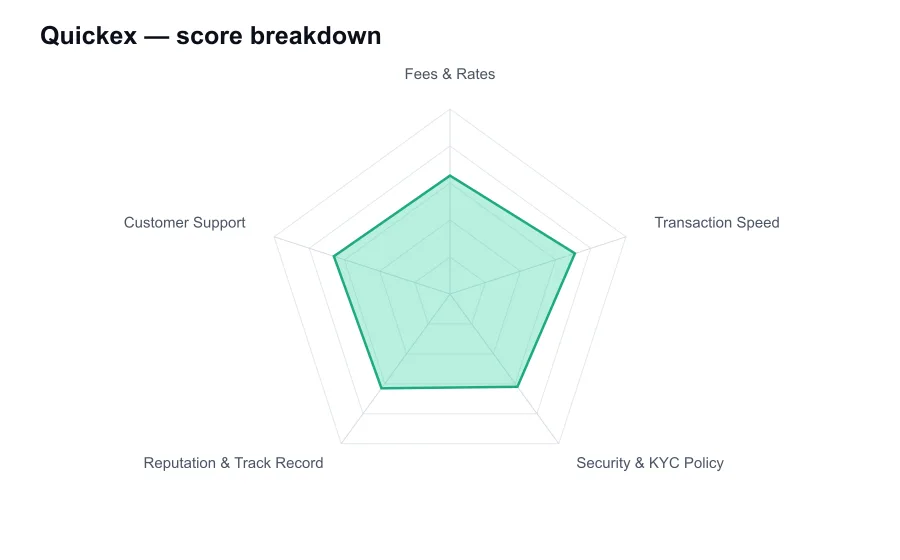
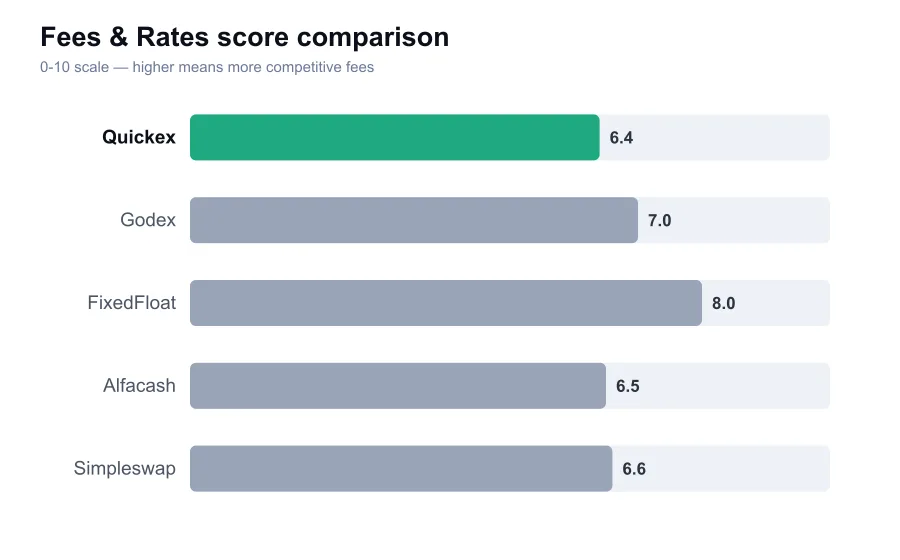
| Fees & Rates | 6.4 | Advertised 0.5% fee, but spread varies by pair |
| Transaction Speed | 7.1 | Usually minutes after the deposit confirms |
| Security & KYC Policy | 6.2 | No account by default, AML checks can pause swaps |
| Reputation & Track Record | 6.3 | Operating since 2018, with a limited public footprint |
| Customer Support | 6.6 | 24/7 chat and email, quality matters most on holds |
What is Quickex?
How Quickex Works
- Choose the crypto pair and enter the amount
- Select a fixed or floating rate where available
- Enter a receiving wallet address
- Send the exact deposit asset to the generated address
- Wait for confirmations and receive the exchanged asset
KYC
| Requirement | optional |
|---|---|
| Notes | KYC is not normally requested before a swap, but Quickex may request identity and source-of-funds information under its AML procedures. |
Supported Assets
| Notable coins | Bitcoin, Ethereum, Tether, USD Coin, Litecoin, Monero, Solana |
|---|
How to Use Quickex Safely
- Compare the final receive quote with at least two services
- Match the token and blockchain network exactly
- Use a fixed rate for time-sensitive payments
- Send a small test amount before a large first swap
- Keep wallet and transaction records in case AML asks for context
Review Summary
Quickex is a non-custodial instant crypto exchange aimed at people who want to swap assets without opening a trading account or learning a conventional exchange interface. It sits in the same broad category as ChangeNOW, StealthEX, SimpleSwap, and LetsExchange. The pitch is straightforward: select a pair, enter a destination wallet, send crypto, and receive the output asset. That simplicity is real, though it also means Quickex is a conversion service, not a proper venue for active traders who need an order book, advanced order types, or transparent market depth.
The service is designed around one-off swaps rather than account-based custody. Quickex generates a deposit address for a transaction and routes the order through its liquidity partners. You don't leave funds parked on the platform in the way you would at Binance or Kraken. That reduces one category of exchange risk, namely a long-term custodial balance becoming inaccessible. It does not remove transaction risk. Once funds are sent to a generated address, the swap depends on the provider's systems, its liquidity sources, blockchain confirmations, and compliance checks.
Quickex markets floating and fixed-rate exchanges. Floating-rate orders follow the market until execution, which can work well in calm conditions but exposes the user to price movement between creating the quote and the provider completing the trade. Fixed-rate orders are more useful for anyone who needs certainty about the received amount, particularly when paying an invoice or moving between volatile assets. The catch is familiar: fixed quotes usually carry a wider spread, and the rate can disappear if the deposit arrives late or the network fee changes sharply.
Its pricing is the area where buyers should stay alert rather than trusting a headline claim. Quickex has advertised a 0.5% service fee for standard exchanges, but that is not the complete economic cost of every transaction. The quoted amount can include liquidity-provider spread, network costs, and pair-specific pricing differences. This is common across instant exchangers, but Quickex does less than a major spot exchange to make the components of execution easy to audit. Compare the final receive amount against two alternatives before sending, especially on BTC, ETH, USDT, and other highly liquid pairs.
For small convenience swaps, the pricing can be acceptable. A user converting a modest amount of Litecoin into USDT may reasonably value a quick, account-light process more than shaving a few basis points from execution. For larger swaps, the gap versus a liquid centralised exchange can become expensive. On a deep venue, a trader can inspect the order book, place a limit order, and see trading fees separately from withdrawal fees. Quickex gives up that visibility in exchange for speed and less account friction. That's a fair trade for some people, but it isn't automatically a cheap one.
Speed depends far more on the assets involved than the marketing copy suggests. A swap between fast networks can finish in minutes after the deposit confirms. Bitcoin deposits can take longer, and congested Ethereum transactions may add meaningful delay before Quickex can process the order. The stated exchange time is generally around five to thirty minutes once the deposit is confirmed, though a difficult route, a thinly traded asset, or several confirmation requirements can turn that into a much longer wait. Anyone moving money against a deadline should test with a small amount first.
Quickex does offer useful status tracking, and that matters. Instant exchange complaints often begin because a customer sees a blockchain transaction confirmed but has not yet received the output asset. A transaction ID and support ticket trail give the user something concrete to check. Still, the experience remains less controllable than trading directly on an exchange. You cannot simply cancel after a market move, choose a different execution venue, or see exactly where the order is waiting. The interface is simple because a lot of complexity is hidden from the customer.
On privacy, Quickex is better described as no-registration by default rather than guaranteed anonymous. The standard swap flow does not require users to create an account or submit identity documents. That is attractive to people who dislike handing over personal data for an occasional conversion. Yet Quickex has an AML policy and can request KYC documentation where an automated risk system flags a transaction, a wallet, a jurisdiction, or a transaction pattern. That can result in a swap being paused while the user is asked for identification or source-of-funds information.
That policy is not unusual, and pretending otherwise would be misleading. Nearly every serious instant exchanger uses chain analytics and reserves the right to investigate flagged funds. The concern is what happens once a hold begins. In that moment, a no-account product can feel less reassuring because users have no established relationship, no published service-level guarantee, and limited leverage beyond support correspondence. Don't send funds connected to gambling sites, mixers, sanctions exposure, ransomware allegations, or unclear third-party activity if you cannot document their origin. A privacy-focused swap interface is not a shield from financial compliance.
Quickex's non-custodial structure is a positive, but the term should be used carefully. The service does take custody of the deposited cryptocurrency during the exchange process. It simply does not operate as a wallet where customers maintain a standing balance. Security therefore rests on its operational controls, partner selection, wallet infrastructure, and AML processes, none of which are independently transparent at the level expected from a publicly regulated exchange. There is no proof-of-reserves framework that materially helps a customer judge short-term swap risk.
The company's public track record is serviceable rather than exceptional. Quickex has been operating since 2018 and is known in the instant-swap market, but it does not have the scale, licensing footprint, or long history of Kraken, Coinbase, or Bitstamp. User reviews are mixed in the predictable way for this sector. Many report a clean completed swap. The dissatisfied cases tend to involve delayed orders, rate changes after a floating quote, and compliance reviews. Those complaints don't prove misconduct, but they are a reminder that instant exchange convenience comes with less recourse than a major regulated platform.
Customer support is available around the clock through the site's live chat and email channels. For ordinary issues such as an unconfirmed deposit or a wrong memo field, responsive support can make a major difference. Quickex's support material and transaction page are adequate, though they don't eliminate the need to understand the asset being sent. Sending USDT on the wrong network, omitting a required destination tag, or using a token contract the service does not support can create a manual recovery problem. Those are exactly the cases where instant exchangers tend to look less effortless.
Quickex is best used as a utility, not as a primary crypto home. It can be a practical route for a wallet-to-wallet swap, especially for users who already understand confirmations, network selection, and the difference between fixed and floating rates. It is a weaker choice for high-value conversions, frequent trading, or anyone who wants guaranteed pricing transparency and formal dispute channels. The lack of routine registration is convenient, but users should not confuse convenience with a promise that KYC can never occur.
My view is that Quickex is competent but not compelling enough to use blindly. It earns credit for a direct interface, non-custodial design, and fixed-rate option. Its weak points are the opaque all-in pricing, modest public transparency, and the same compliance-hold risk that shadows this whole category. Check its quote against at least two competitors, send a test transaction if the amount matters, and keep records of the source of your funds. Used with that discipline, it can do the job. Used casually for a large urgent transfer, it is harder to recommend.
Pros & Cons
| Pros | Cons |
|---|---|
| No account required for the normal swap flow | — |
| Fixed-rate and floating-rate quote options | — |
| Wallet-to-wallet service with no standing balance | — |
| Simple transaction tracking | — |
Frequently Asked Questions
Does Quickex charge a 0.5% fee?
Quickex has advertised a 0.5% service fee, but the final quote may also reflect liquidity spread and blockchain costs. Compare the receive amount, not just the headline fee.
Does Quickex require KYC?
Routine swaps generally do not require account registration or KYC. Its AML policy allows Quickex to request identity or source-of-funds documents for flagged transactions.
Can I keep crypto in a Quickex account?
No. Quickex is intended for individual exchanges rather than a persistent custodial account. You provide a receiving wallet address for each swap.
Why is my Quickex swap still pending after I sent funds?
Quickex normally needs the deposit to receive the required blockchain confirmations before it can execute. Bitcoin and congested Ethereum transfers can take longer than fast-chain deposits.
What happens if a floating Quickex rate moves?
A floating-rate order is settled at the rate available during execution, not necessarily the estimate shown when you created it. Use a fixed-rate quote when the received amount is critical.
Can I send USDT on any network to Quickex?
No. The deposit network must exactly match the network selected in the order. Sending USDT on a different chain can require manual recovery and may not be recoverable.