| Best for | Long operating history since 2013, No routine account registration for many swaps, Simple fixed-order exchange flow, Useful selection of mainstream crypto pairs |
|---|---|
| Not for | Spread is harder to audit than exchange fees, AML reviews can interrupt a supposedly simple swap, Not designed for active traders or large orders |
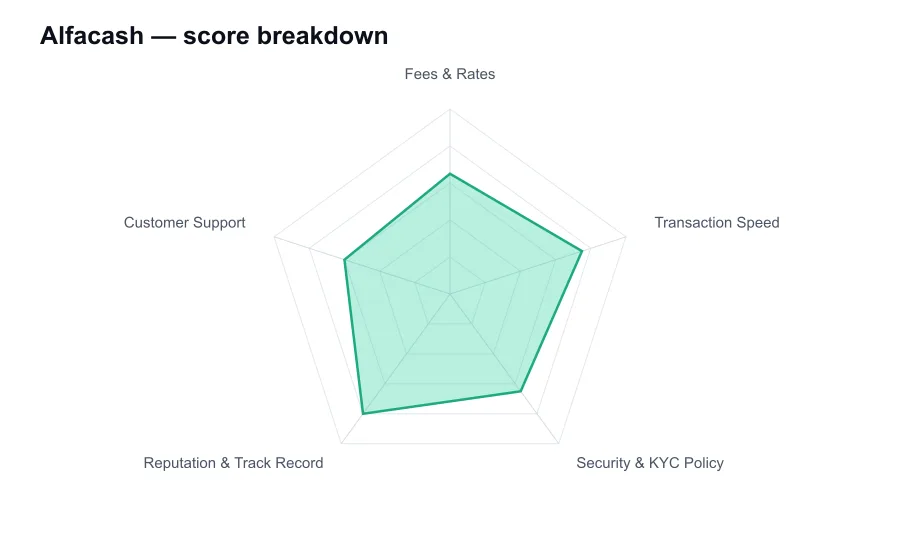
| Criterion | Score | Note |
|---|---|---|
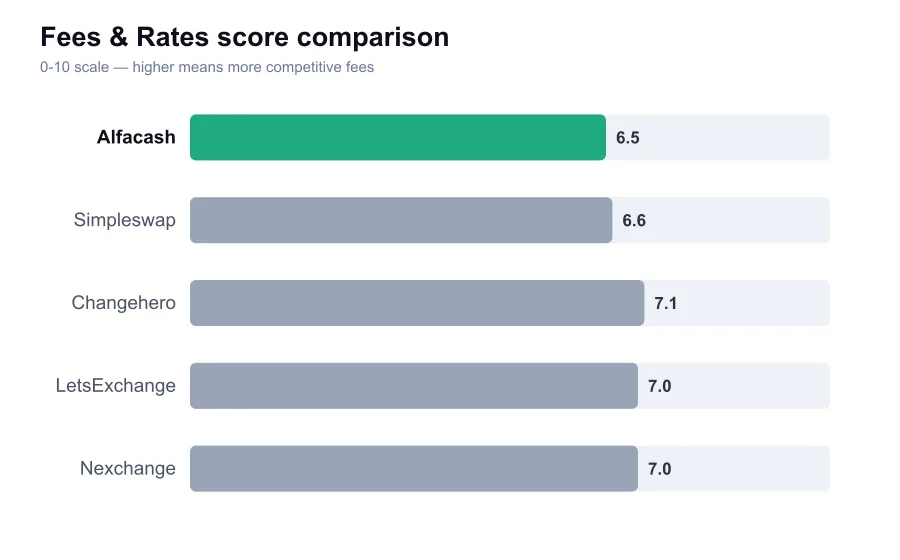
| Fees & Rates | 6.5 | Costs are mainly embedded in the live quote. |
| Transaction Speed | 7.5 | Fast after required blockchain confirmations. |
| Security & KYC Policy | 6.5 | AML checks may apply despite no routine signup. |
| Reputation & Track Record | 8.0 | Operating under the Alfacash brand since 2013. |
| Customer Support | 6.0 | Order support is available, but not premium live service. |
What is Alfacash?
How Alfacash Works
- Select the asset you want to send and receive
- Enter the destination wallet address
- Review the quoted amount and order details
- Send the requested crypto to the generated address
- Track confirmations and receive the converted asset
KYC
| Requirement | tiered |
|---|---|
| Notes | Many swaps do not require routine registration, but Alfacash may request identity and source-of-funds documents during AML or risk reviews. |
Supported Assets
| Notable coins | Bitcoin, Ethereum, Litecoin, Tether, USD Coin, Dash, Monero |
|---|
How to Use Alfacash Safely
- Compare the final received amount with another exchange before sending
- Confirm the coin and network match the receiving wallet
- Save the order ID and deposit transaction hash
- Test a new address with a small transaction
- Do not send funds until the displayed order details are correct
Review Summary
Alfacash is an old-school instant crypto exchange service, the sort of business that existed before every swap site copied the same glossy interface and promised hundreds of assets. It has operated under the Alfacash brand since 2013 and focuses on straightforward exchanges, card purchases, and a small set of payment methods rather than building a full trading venue. That makes it a practical tool for a user who wants to convert one asset into another without opening an account at a large centralised exchange.
The service sits somewhere between a traditional exchanger and a modern instant-swap platform. You choose a pair, enter a receiving address, send funds, and Alfacash handles the conversion. There is no order book for users to inspect and no advanced trading screen. This is convenience trading, so the important question is not whether it has charting tools. It is whether the quoted rate is fair, the transfer arrives promptly, and support responds if a transaction goes wrong.
Alfacash's age is one of its best arguments. A service that has been available since 2013 has survived bear markets, exchange failures, banking disruptions, and changing compliance expectations. That does not make it equal to a heavily regulated exchange with published proof of reserves, but it does separate Alfacash from anonymous swap sites that appear for a year and disappear after a few bad reviews. The company has a recognisable public operating history, which matters a great deal in this corner of crypto.
Its fee presentation needs a careful reading. Alfacash does not work like an exchange charging every customer a transparent maker or taker percentage. The economic cost is usually folded into the quoted exchange rate, together with network fees and liquidity-provider pricing. That can be perfectly reasonable for a small, fast conversion, but it makes direct comparisons harder. Before sending funds, compare the amount Alfacash says you will receive with Kraken, Binance, Coinbase Advanced, or a self-custody swap route.
For major pairs such as BTC to USDT, ETH to BTC, or LTC to BTC, the quote is often competitive enough for a convenience service. For card purchases and less liquid coins, it can get expensive quickly. Card processors add their own costs, and the spread on a small altcoin conversion can be wider than a customer expects. Alfacash is not where I would repeatedly trade six-figure positions. It is far more convincing for a one-off conversion where avoiding an account, bank transfer, and exchange withdrawal delay has genuine value.
Speed is usually good once a deposit has enough blockchain confirmations. A typical crypto-to-crypto transaction can be completed in minutes for fast networks, while Bitcoin and Ethereum transfers naturally depend on network congestion and the fee attached to the customer's transaction. Alfacash cannot process a Bitcoin deposit before the network confirms it, despite what impatient users may assume. Fixed-rate orders can be especially useful during a sharp market move, although a stale or underfunded deposit can still create complications.
The service does a better job than many instant exchangers of making the order flow understandable. It provides a receiving address, an order identifier, and a status page rather than asking customers to send funds into a vague wallet and hope for the best. Still, this remains a non-custodial transaction flow only in a limited sense. Alfacash temporarily receives the deposited asset and controls the conversion process. You are trusting its systems and liquidity partners for that interval.
That trust question leads to KYC and AML. Alfacash has historically allowed many crypto swaps without an account or routine identity verification, which is a major attraction for privacy-minded users. It is not a guarantee of anonymity. The company can request identity documents, source-of-funds information, or wallet-related clarification where an order triggers compliance checks. Anyone who treats a no-registration interface as a promise that no questions will ever be asked is taking an unnecessary risk.
This is also why users should avoid sending a large amount for their first transaction. Test the route with a modest sum, ensure the destination network is correct, and retain the order ID and transaction hash. If an AML review occurs, a customer who cannot explain the source of funds may face a delayed exchange or refund process. That policy is frustrating, but it is now common among services that work with external liquidity and payment providers. Alfacash is not unusual here, though its public compliance detail could be clearer.
On technical security, Alfacash does not offer the account controls available at a full exchange because many orders do not require a permanent account. That removes password-reset and account-takeover risks for casual users, but it also means users have fewer tools to protect an order after submitting it. The most important security control is your own address verification. A wrong chain selection or copied malware address cannot be rescued by a responsive support team.
The asset selection is broad enough for mainstream exchange needs, including Bitcoin, Ethereum, Litecoin, stablecoins, and several payment-oriented coins. It should not be mistaken for a deep altcoin marketplace. Availability varies with liquidity, and supported network variants matter. Sending USDT on one chain while choosing a destination address on another is a classic mistake. The quote screen needs to be checked closely, particularly for stablecoins where ticker symbols can hide different networks.
Customer support is adequate rather than exceptional. Alfacash offers a contact route and order-specific assistance, and its team has a better chance of resolving a simple underpayment or destination issue when the customer supplies the transaction hash promptly. Responses are less reassuring when a case involves a compliance review, a payment-card dispute, or a chain recovery request. There is no polished 24-hour live desk comparable with Binance or Coinbase, and customers should not expect instant human intervention in every case.
Reputation is solid for a specialist exchanger, though it is not spotless or beyond criticism. Reviews of instant exchanges tend to be polarised because a successful swap feels routine while a delayed AML case can feel like a disaster. I would give more weight to Alfacash's long operating record, visible order process, and established brand than to a handful of extreme reviews in either direction. It has earned a place on a shortlist, but not a blind recommendation for large purchases.
My view is simple. Alfacash remains useful because it is established, uncomplicated, and often quick for mainstream crypto conversions. It loses points for rate opacity, limited public detail about its operational safeguards, and support that is more functional than luxurious. Use it for a sensibly sized swap after comparing the final received amount. If you need recurring trading, institutional custody, full fee transparency, or dependable fiat rails, a major regulated exchange will serve you better.
Pros & Cons
| Pros | Cons |
|---|---|
| Long operating history since 2013 | — |
| No routine account registration for many swaps | — |
| Simple fixed-order exchange flow | — |
| Useful selection of mainstream crypto pairs | — |
Frequently Asked Questions
Does Alfacash require an account?
Many crypto swaps can be started without creating a permanent account. Alfacash can still request identity or source-of-funds information if an order is flagged under its AML procedures.
How old is Alfacash?
Alfacash has operated under its current brand since 2013, giving it a much longer public record than most instant-swap services.
Why did my Alfacash order take longer than expected?
The service must first receive the required blockchain confirmations. Bitcoin and Ethereum deposits can slow down during congestion, and an AML review can add further delay.
Can I see a standard trading fee before swapping?
Alfacash generally presents the final exchange quote rather than a maker and taker fee schedule. Compare the amount you will receive, including network cost, before you send funds.
What happens if I send less than the requested amount?
A short payment can leave an order pending or require support intervention. Keep the order ID and deposit transaction hash so support can identify the payment.
Should I test a new receiving address first?
Yes. A small test order is sensible, particularly with stablecoins and multi-chain assets, where selecting the wrong network can lead to an unrecoverable loss.