| Best for | No routine account registration, 1,400+ advertised assets, Fixed and floating rate routes, Several 24/7 support channels |
|---|---|
| Not for | Rates include opaque partner spread, AML screening can lead to KYC requests, No order-book execution transparency, Thin assets may have weaker routes |
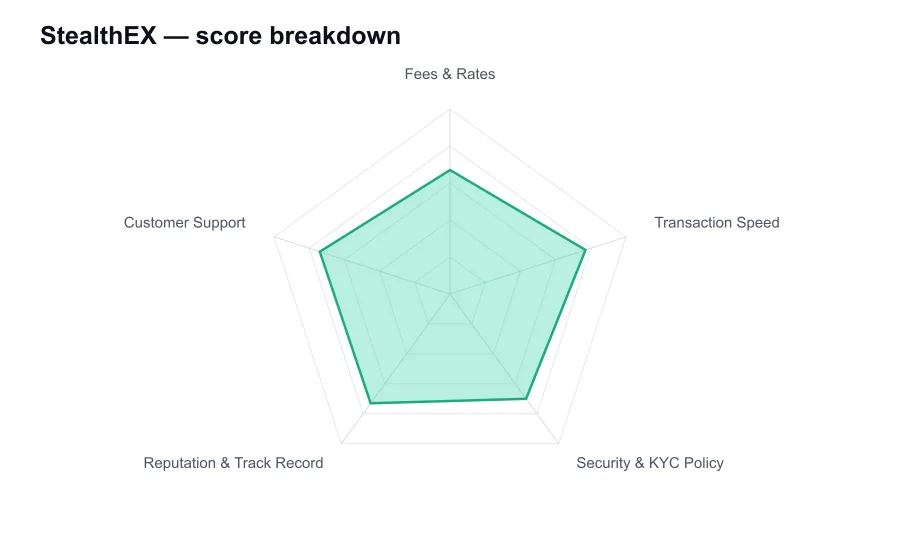
| Criterion | Score | Note |
|---|---|---|
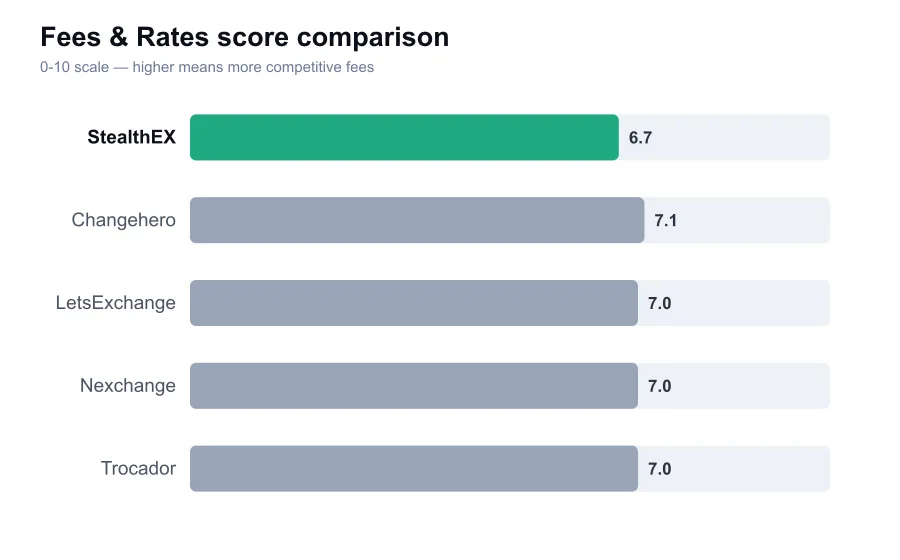
| Fees & Rates | 6.7 | No simple universal fee, compare final quotes |
| Transaction Speed | 7.7 | Usually quick after network confirmations |
| Security & KYC Policy | 7.0 | No-account flow, with AML-triggered KYC possible |
| Reputation & Track Record | 7.3 | Known instant-swap brand operating since 2018 |
| Customer Support | 7.4 | 24/7 chat, email, and community contact channels |
What is StealthEX?
How StealthEX Works
- Select the asset to send and the asset to receive
- Choose a floating or fixed quote where available
- Provide the receiving wallet address
- Send the requested asset to the deposit address
- Follow the transaction page until delivery
KYC
| Requirement | optional |
|---|---|
| Notes | StealthEX does not apply routine mandatory KYC, but can require verification under AML procedures for transactions that trigger risk controls. |
Supported Assets
| # of coins | 1400 |
|---|---|
| Notable coins | Bitcoin, Ethereum, Tether, USD Coin, Monero, Solana, Dogecoin, Toncoin |
| Networks | Bitcoin, Ethereum, Tron, BNB Smart Chain, Solana, Polygon |
How to Use StealthEX Safely
- Compare the final output quote on at least two services
- Check the asset ticker and chain before depositing
- Use a fixed-rate quote for a time-sensitive payment
- Keep your order link and transaction hash
- Do not send funds whose origin you cannot document if asked
Review Summary
StealthEX is a non-custodial instant exchange service that has built its identity around privacy, broad coin support, and a deliberately account-light user experience. It belongs to the same family as SimpleSwap and ChangeNOW, but its branding is more openly directed at users who prefer not to create an exchange profile for every conversion. The service lets a customer select a pair, provide a receiving address, send a deposit, and receive the swapped asset. It is simple in the right ways, although the privacy message needs more careful interpretation than the name suggests.
The company has operated since 2018 and has become a recognisable brand in the instant-swap segment. It advertises support for a very large selection of coins and tokens, often citing more than 1,400 assets and tens of thousands of exchange pairs. That scope is a practical advantage. Users can often move between a major asset and a smaller token without creating several exchange accounts. Yet breadth can lead to a false sense of uniformity. Bitcoin-to-USDC is a very different transaction from a thinly traded token route, and the latter may have less attractive liquidity, higher minimums, or intermittent availability.
StealthEX is not an exchange with its own public order book. It sources conversion liquidity through partners and delivers a quoted amount to the customer. This means it is closer to an aggregator than a venue like Coinbase Advanced or Kraken Pro. The model is good at reducing friction. It is weaker for price discovery. The user cannot inspect available bids, see which partner will fill the order, or decide to wait for a better level. The service is selling a completed route, not a trading environment.
Fees are quote-driven, and that is the first point a cost-conscious user should understand. StealthEX has said that it does not add an extra hidden fee beyond what is reflected in the exchange rate, but the visible rate necessarily includes its margin, liquidity costs, and network costs where relevant. That wording should not be read as free trading. The only useful comparison is the final amount delivered to your wallet. On major pairs, check StealthEX against SimpleSwap, ChangeNOW, and a liquid exchange before committing. Differences can be modest, but they can also be meaningful on larger orders.
The platform provides floating and fixed-rate options for many routes. Floating is usually appropriate for a casual conversion where the user wants the best current estimate and accepts market movement. Fixed rate is the better option if a transfer needs to produce a predictable result. A fixed quote can protect against a sharp move while the deposit is confirming, but it normally embeds a safety buffer. It is also dependent on the user funding promptly and accurately. Send less than required, send late, or select the wrong network, and the smooth fixed-rate experience turns into a support case.
Speed is generally a strong point. For an uncomplicated route on a fast network, StealthEX can complete the process quickly after the incoming transaction has enough confirmations. Its own guidance commonly frames exchanges as taking a few minutes, though no honest reviewer should promise that outcome universally. Bitcoin confirmation policy, Ethereum gas pressure, liquidity-provider delays, maintenance at a partner, and a compliance flag can all extend the timeline. The customer sees a single service, but several systems may sit behind that one interface.
StealthEX's no-registration design is useful for basic operational privacy. A visitor can create a swap without handing over an email address, phone number, or password. That lowers the data footprint compared with opening a full trading account. It also reduces phishing exposure from a stored account profile. But a no-account process can be less forgiving if a transaction becomes complicated. Keep the order link, transaction ID, amount, and wallet details. Without an account dashboard, those records are your proof of what happened.
The harder privacy question is KYC. StealthEX says that it does not require mandatory KYC for ordinary swaps, but it uses AML procedures and can ask a user to complete verification if a transaction is judged suspicious. That includes cases involving sanctioned exposure, high-risk services, stolen-fund alerts, or unclear source patterns. The distinction is important. It is fair to call StealthEX no-KYC by default. It is not fair to call it KYC-proof. Anyone whose priority is avoiding any chance of a compliance request should not send funds through a commercial instant exchanger at all.
Security benefits from the lack of long-term platform balances. There is no reason to keep assets sitting in a StealthEX wallet because StealthEX does not operate that kind of customer account. This reduces the attraction of a mass account takeover scenario. The counterpoint is that users must trust the service during execution, and its technical security practices are not exposed in the detailed, independently audited form that would make a risk assessment easy. The platform's operational record is more relevant than a marketing label, and public information remains limited compared with regulated exchanges.
Reputation is decent within this niche. StealthEX has been around long enough to outlast many short-lived swap brands, it has partnerships and integrations, and it has a substantial body of user feedback. The negative reports follow familiar instant-exchange themes: an order takes longer than expected, the rate changes on a floating order, or an AML review requires documentation. There have also been customers unhappy with the process of resolving flagged transfers. Such reports should not be dismissed as noise, because a held transaction is precisely the moment a provider's real policies become visible.
Support is one of StealthEX's more visible selling points. It offers 24/7 live chat and email support, with Telegram and social channels providing additional contact paths. That availability matters because swaps do not wait for office hours. The quality of help can still vary with the issue. Support can explain confirmations and relay information to a liquidity partner, but it cannot make a blockchain transaction reversible or instantly override a compliance investigation. Set expectations accordingly. A helpful agent is valuable, but it is not a guarantee of immediate release.
StealthEX makes the most sense for users who already manage their own wallets and understand how coin and network selection work. It is especially convenient for an occasional conversion involving an asset that is awkward to access on a single mainstream exchange. It is not ideal for a newcomer sending their first large transaction, because the service's simplicity can obscure the need to verify every detail. It is also not the best value for regular high-volume trading. Those users should normally choose a transparent spot market or an on-chain DEX with known pool fees.
For cautious users, the right workflow is bluntly practical. Check the exact quoted output at more than one service. Use a fixed-rate route if the amount is important. Confirm that the receiving wallet can accept the selected chain and token. Start with a small test transfer where a route is unfamiliar. Keep evidence of how you acquired the funds, because the absence of routine KYC does not prevent a source-of-funds question later. Those precautions make the service far less risky to use.
I rate StealthEX as one of the stronger privacy-oriented instant exchangers, but not as a magical anonymous shortcut. Its range, speed on standard routes, and account-free flow are legitimate strengths. Its main weaknesses are the opaque nature of aggregator pricing and the unavoidable possibility of an AML hold. It earns a place in a self-custody toolkit, particularly for users who compare quotes before acting. It should not be the only route for a high-stakes transfer or for someone who cannot tolerate conditional verification.
Pros & Cons
| Pros | Cons |
|---|---|
| No routine account registration | — |
| 1,400+ advertised assets | — |
| Fixed and floating rate routes | — |
| Several 24/7 support channels | — |
Frequently Asked Questions
Does StealthEX require account registration?
No. StealthEX normally lets users create an exchange without opening an account or supplying an email address. Keep the transaction link and deposit hash because there is no account dashboard.
Can StealthEX ask for KYC?
Yes. KYC is not mandatory for every user, but StealthEX may request verification and source-of-funds information if AML systems flag a transaction.
How many cryptocurrencies does StealthEX support?
StealthEX advertises more than 1,400 assets and many thousands of pairs. A listed asset may still have different availability depending on the network and liquidity route.
Is StealthEX actually free if it says there are no hidden fees?
No instant exchange route should be assumed free. Its economics are reflected in the displayed quote through liquidity pricing, service margin, and applicable network costs.
What does fixed rate mean on StealthEX?
A fixed-rate order is intended to deliver the quoted output amount if you fund it correctly within the stated period. It is preferable when the exact received amount matters.
Why can a StealthEX transaction take longer than a few minutes?
The service must wait for required blockchain confirmations and may depend on a liquidity partner. Bitcoin confirmations, Ethereum congestion, maintenance, or AML review can add time.