| Best for | More than 1,000 advertised supported assets, Fixed and floating rate options, No routine account registration, API and wallet integration options |
|---|---|
| Not for | No single transparent all-in fee schedule, KYC can be triggered by AML checks, Small-token routes can be expensive or unavailable, Not a substitute for an order-book exchange |
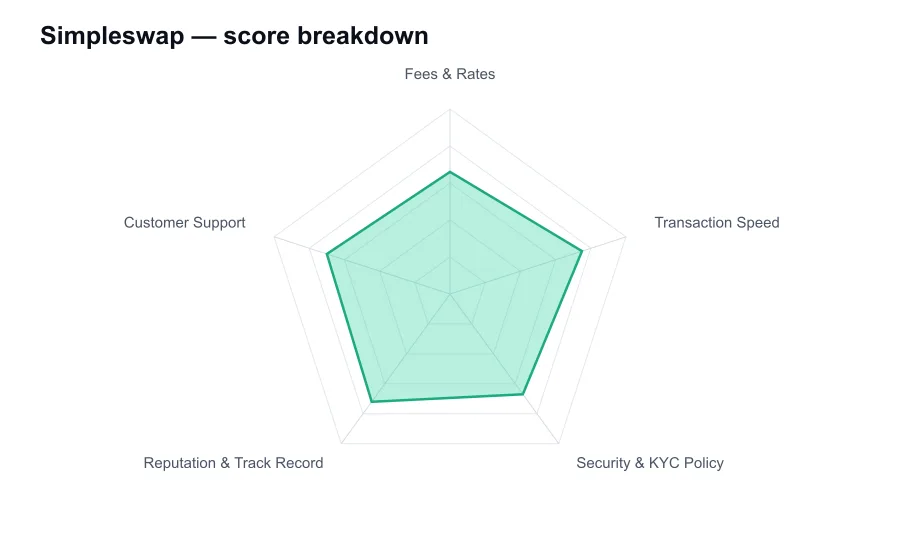
| Criterion | Score | Note |
|---|---|---|
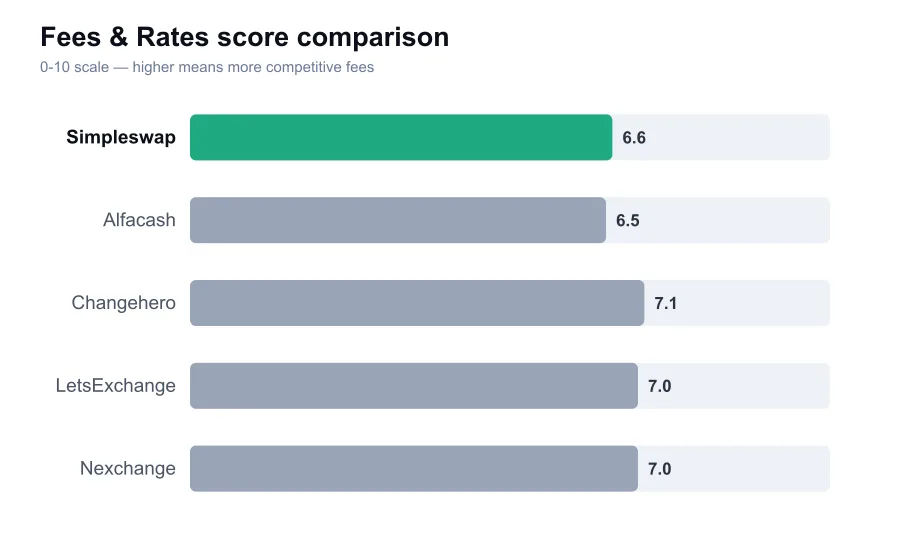
| Fees & Rates | 6.6 | Quote-based pricing, with spread varying by route |
| Transaction Speed | 7.5 | Fast on common routes after confirmations |
| Security & KYC Policy | 6.7 | Non-custodial format, conditional AML and KYC checks |
| Reputation & Track Record | 7.2 | Established in 2018 with broad wallet visibility |
| Customer Support | 7.0 | 24/7 chat and a useful help centre |
What is Simpleswap?
How Simpleswap Works
- Choose the send and receive assets
- Select fixed or floating rate if offered
- Enter the destination wallet address
- Transfer the requested amount to the deposit address
- Track the order until the output reaches your wallet
KYC
| Requirement | optional |
|---|---|
| Notes | SimpleSwap normally allows swaps without registration, but may request KYC and source-of-funds documents under its AML procedures. |
Supported Assets
| # of coins | 1000 |
|---|---|
| Notable coins | Bitcoin, Ethereum, Tether, USD Coin, BNB, Solana, Monero, Dogecoin |
| Networks | Bitcoin, Ethereum, Tron, BNB Smart Chain, Solana |
How to Use Simpleswap Safely
- Compare the receive quote with competing instant exchangers
- Choose the exact token network before funding the order
- Use fixed rate for a payment with a strict output amount
- Save the order ID and deposit transaction hash
- Test a new route with a small transaction
Review Summary
SimpleSwap is one of the better-known names in the account-light crypto conversion market. Founded in 2018, it offers instant swaps through a web interface, API products, and wallet integrations. Its basic proposition is similar to Quickex or StealthEX: users select two assets, receive a deposit address, and get the converted asset in a personal wallet. The difference is scale and polish. SimpleSwap has built a fairly broad asset catalogue and has become a familiar option for users who want a one-time swap without maintaining a balance on a centralised exchange.
This is not a traditional exchange in the trader's sense. There is no visible order book, no charting suite, and no ability to place a patient limit order at a chosen price. SimpleSwap aggregates liquidity and presents a conversion quote. That makes it approachable for newcomers, but it also asks them to accept a less transparent execution model. You are buying convenience and access to many routes, not the lowest possible price on every pair. For a simple exchange between wallet holdings, that can be perfectly reasonable. For regular trading, it is usually the wrong tool.
The platform offers both floating and fixed-rate exchanges. Floating rates are often more competitive at the moment a quote is generated, but the final amount can change while the deposit travels through the network and the order reaches liquidity providers. Fixed-rate swaps put more certainty around the result, which is valuable if you need to receive a defined amount of stablecoins or are paying someone in a specific asset. The fixed option should not be treated as free insurance. Its quote can be wider, and users must deposit within the stated time window and send the correct amount.
SimpleSwap does not publish one simple universal trading commission that lets a user calculate every cost in advance. The displayed quote is the meaningful number. It may contain network fees, provider fees, liquidity spread, and the risk premium built into fixed execution. That is standard for this business model, but it remains a drawback compared with Kraken Pro or Coinbase Advanced, where trading fees, market price, and withdrawal cost are more easily separated. A user who does not compare quotes can pay substantially more than expected on a liquid pair.
The service fares better on range than on absolute price transparency. SimpleSwap has promoted support for more than 1,000 crypto assets, which is genuinely useful for holders of smaller tokens and for cross-chain conversions that a single exchange may not list. Yet a long list is not the same thing as deep, reliable liquidity. Smaller assets can have higher minimums, a poorer rate, or temporarily unavailable routes. Before buying a token elsewhere on the assumption that SimpleSwap will convert it later, check that the exact token and network are currently selectable.
Speed is generally good for uncomplicated routes. Once a deposit is detected and receives the required confirmations, many swaps finish in a matter of minutes. The word "instant" needs context, though. A Bitcoin deposit can take materially longer than a Solana or Litecoin transfer. ERC-20 routes can be slowed by Ethereum congestion, and some assets require more confirmations than others. A supposedly quick swap can also pause while a liquidity provider replenishes inventory or while a compliance system reviews the transfer. It is efficient, but it is not a guaranteed real-time service.
The interface is one of SimpleSwap's strengths. It makes the required choices clear enough for a first-time user and includes a transaction page where an order can be followed. Wallet integrations and an API also make it more relevant than a bare website. That said, the simple design can hide important details. The user still bears responsibility for the recipient address, memo or destination tag, selected chain, and amount sent. There is no undo button after a crypto transfer. A polished screen cannot rescue an order funded on the wrong network.
SimpleSwap describes itself as non-custodial, which is broadly accurate in the sense that it does not provide a standard customer trading balance. During the transaction, however, it receives the deposit and coordinates the conversion. The user is therefore relying on the platform for a short but meaningful custody period. This distinction matters after an error or delay. Self-custody before and after the swap is valuable. It does not mean a transaction in progress is decentralised or trustless.
KYC is another area where marketing language needs a realistic reading. SimpleSwap's ordinary flow does not demand an account or identity check from every user. It has an AML and KYC policy, however, and can request documentation when a transaction triggers compliance controls. That may include identity documents, a selfie, or information about the source of funds. Some customers choose instant exchanges precisely to avoid routine verification, then feel misled when a transaction is held. The more accurate expectation is that verification is conditional, not absent.
The company has accumulated more recognition than many smaller instant exchange brands. It has operated since 2018, supports a substantial user base, and is integrated into parts of the wallet ecosystem. Still, it does not carry the regulatory stature or public financial disclosure of a top-tier centralised exchange. Reviews range from praise for smooth swaps to complaints about delayed payouts, changed floating rates, and compliance-related holds. That is not unique to SimpleSwap, but a prospective user should judge the service by how it fits their risk tolerance rather than by review averages alone.
Support is available 24 hours a day through live chat and email, and SimpleSwap has a reasonably developed help centre. For a normal swap, this is enough. The real measure is how support handles a difficult situation: an underpayment, a tag omission, a stuck confirmation, or an AML request. Public accounts on those cases are inconsistent. Some users report rapid resolutions, while others describe long exchanges with support. That uncertainty is one reason not to use any instant exchanger as the sole route for funds you cannot afford to have unavailable for several days.
SimpleSwap is a more attractive choice than smaller competitors if asset choice matters. Its integrated partner model and broad catalogue can save time when moving between a major coin and a less common asset. It also works well for users who have already decided that convenience matters more than extracting the best possible execution. It is less attractive for a trader swapping frequently between BTC, ETH, and stablecoins. On highly liquid pairs, a major exchange or decentralised exchange may provide a better price with more visible mechanics.
There are a few habits that make SimpleSwap materially safer to use. Check the exact receive amount at two or three providers. Use fixed rate if the output amount matters more than a slightly better estimate. Confirm whether USDT means Ethereum, Tron, Solana, or another network before sending. Save the order ID and blockchain transaction hash. Those steps sound basic, but most painful instant-exchange cases begin with a wrong network or an assumption that a displayed estimate was a guaranteed settlement price.
My judgment is that SimpleSwap is a solid convenience product with better range and usability than many anonymous-looking swap sites. It is not cheap by default, and its conditional KYC process should be taken seriously. The service deserves consideration for occasional swaps, wallet users, and obscure-asset routes. It does not deserve blind loyalty, especially for large conversions where a quote comparison can save real money. Use it for what it is, a practical aggregator with useful coverage, rather than pretending it offers the transparency of an exchange order book.
Pros & Cons
| Pros | Cons |
|---|---|
| More than 1,000 advertised supported assets | — |
| Fixed and floating rate options | — |
| No routine account registration | — |
| API and wallet integration options | — |
Frequently Asked Questions
How many assets does SimpleSwap support?
SimpleSwap has promoted support for more than 1,000 crypto assets. Availability still depends on the specific token, network, and current liquidity route.
Does SimpleSwap require KYC?
It does not routinely require account registration or KYC before a swap. Its AML policy permits identity and source-of-funds requests for transactions flagged by risk checks.
What is the difference between floating and fixed rates on SimpleSwap?
A floating swap settles at the market rate during execution. A fixed-rate swap targets the quoted output amount, subject to sending the correct deposit within the required time.
Why did my SimpleSwap quote change?
The estimate can change on a floating-rate order because market prices move between quote creation and execution. Fixed-rate swaps are intended for users who need a more predictable result.
Can SimpleSwap exchange USDT across different networks?
It can list routes involving several USDT networks, but you must choose the exact deposit and payout networks shown in the order. Ethereum USDT and Tron USDT are different assets operationally.
Does SimpleSwap hold a permanent account balance?
No. It is structured around individual swaps to a wallet address rather than a conventional customer balance. Funds are handled during the conversion process only.