| Best for | Wide asset and network coverage, Fixed-rate and floating-rate options, No account for ordinary exchanges, Visible API and partner integration activity, 24/7 support channels |
|---|---|
| Not for | No single published flat fee across all routes, Final quotes can vary with liquidity providers, AML checks can hold a transaction, Temporary custody risk during settlement |
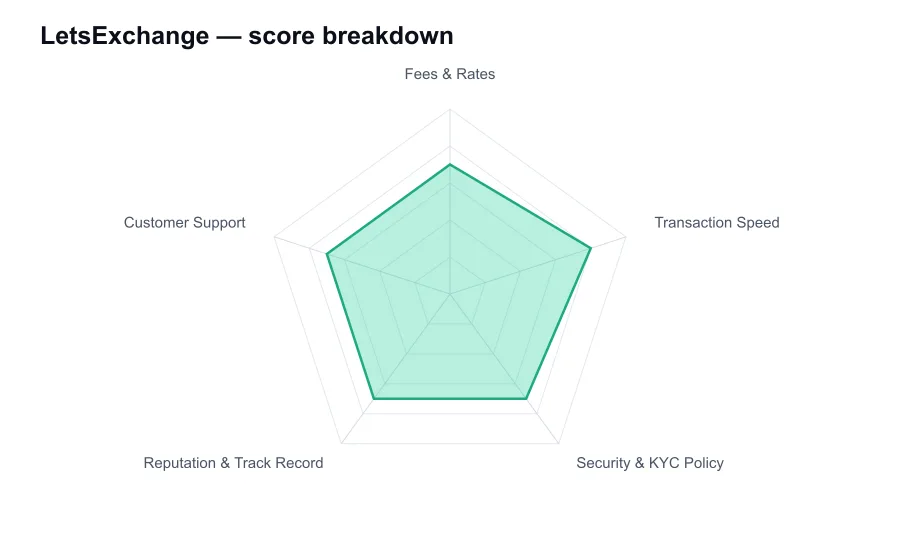
| Criterion | Score | Note |
|---|---|---|
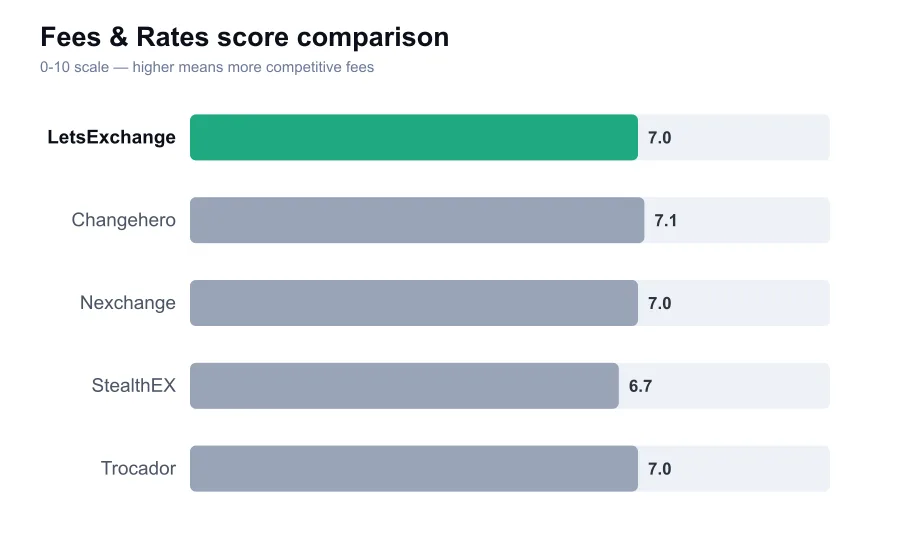
| Fees & Rates | 7.0 | Quote-based pricing can be competitive, but compare final payouts |
| Transaction Speed | 8.0 | Fast execution on liquid routes after blockchain confirmations |
| Security & KYC Policy | 7.0 | No routine account KYC, with AML checks for flagged swaps |
| Reputation & Track Record | 7.0 | Established instant-exchange brand with public integrations |
| Customer Support | 7.0 | 24/7 support channels are stronger than many small swap sites |
| Fact | Value |
|---|---|
| Service type | Instant crypto exchange [source] |
| Rate options | Fixed and floating [source] |
| Registration | Not required for standard swaps [source] |
| Support availability | 24/7 [source] |
| Settlement style | Wallet-to-wallet [source] |
| Compliance checks | AML review for flagged swaps [source] |
What is LetsExchange?
How LetsExchange Works
- Select the asset and network you want to send
- Choose the asset and network you want to receive
- Pick a fixed or floating rate if both are available
- Enter and verify your receiving wallet address
- Send the required amount to the generated deposit address
- Track settlement with the exchange ID and transaction hash
KYC
| Requirement | optional |
|---|---|
| Notes | LetsExchange allows ordinary exchanges without routine registration or KYC. Its AML procedures can trigger an information request or review for a flagged transaction. |
Supported Assets
| Notable coins | Bitcoin, Ethereum, Tether, USD Coin, Solana, BNB, Polygon, Litecoin, Dogecoin |
|---|---|
| Networks | Bitcoin, Ethereum, Tron, Solana, BNB Smart Chain, Polygon, Avalanche |
How to Use LetsExchange Safely
- Compare the exact payout with another live quote
- Select the precise token network on both ends
- Use a fixed rate for a time-sensitive target amount
- Keep the order ID and deposit transaction hash
- Send a small test amount on an unfamiliar route
- Do not leave funds at a generated deposit address
Review Summary
LetsExchange is an instant crypto exchange and swap aggregator that has become one of the more visible names in the account-free conversion market. It is aimed at users who want to exchange assets directly from one wallet to another, without leaving funds on a conventional trading platform. That puts it in the same broad group as ChangeNOW, SimpleSwap, Godex, and FixedFloat, though LetsExchange has put more effort into partnerships and integration tools.
The service is designed around a familiar workflow. Select the asset and network you are sending, pick the asset and network you want to receive, provide a destination address, and transfer the deposit. LetsExchange then routes the conversion through its liquidity arrangements. It is simple enough for a first-time swapper, but the irreversible nature of crypto still means every address and network choice deserves a deliberate check.
LetsExchange supports a large catalogue of assets and networks. That breadth is one of its genuine strengths. It can be useful for swapping between major coins, stablecoins, and more obscure tokens without opening accounts across several exchanges. The catch is that a big list can create false confidence. Availability of a ticker does not guarantee deep liquidity, a good rate, or easy recovery if a user picks the wrong chain.
Fees are not presented as a single universal percentage in the way FixedFloat publishes 0.5% and 1% tiers. LetsExchange generally incorporates its service charge, liquidity pricing, and network costs into the quote. That is common for an aggregator, but it makes comparisons more important. The displayed payout is the figure to judge. A clean interface should not distract from checking what arrives in your wallet.
For major pairs, LetsExchange can produce competitive quotes because it draws on external liquidity rather than depending on one internal book. That is useful during ordinary conditions and can improve asset coverage. It can also mean results vary from one route to another. A quote for BTC to USDT may be excellent at one moment and merely average at the next, depending on the provider selected behind the scenes.
The platform offers both floating-rate and fixed-rate exchange options for supported pairs. Floating rates can give a better initial quote but expose the customer to price movement while a deposit confirms and is processed. Fixed rates reduce that uncertainty, though the rate may be less attractive because LetsExchange has to price in market risk. Users swapping a volatile asset for a specific required amount should usually prefer certainty over a tempting estimate.
Speed is good on normal, liquid routes. A swap can settle shortly after the source transaction receives the necessary confirmations and the liquidity route executes. LetsExchange cannot control Bitcoin mempool congestion, Ethereum gas conditions, or a wallet sending with too little fee. The platform's speed is best understood as execution speed after the blockchain does its part.
This is not a custodial exchange in the conventional sense. LetsExchange does not ask the average user to maintain a trading balance on its site, and the intended result goes directly to a specified external wallet. Yet the service takes custody of the deposit during the conversion. That temporary exposure is the core risk of every instant exchanger, so users should not send more than required and should avoid treating the generated address as reusable.
LetsExchange says users can exchange without registration and without standard KYC. That is a significant convenience, particularly for a straightforward wallet-to-wallet transaction. It should not be read as immunity from compliance checks. The service has AML procedures and can require information for transactions that trigger its controls. Anyone who needs guaranteed anonymity should understand that regulated compliance expectations still reach this category.
Its reputation is stronger than that of a newly launched swap site, in part because of its public integrations and a longer operational presence than many small competitors. LetsExchange has also promoted API and white-label products, which suggests it is trying to be infrastructure as well as a consumer-facing exchange. That is positive evidence of commercial maturity, though it does not turn the service into a regulated custodian or insure a user's transaction.
Customer support is available around the clock through the website and email routes, and LetsExchange has a stronger visible support presence than many bare-bones instant exchangers. For straightforward issues, that is useful. Public sentiment is still mixed in the way it often is for this sector, especially around transactions that enter an AML review or encounter network errors. A fast chat response is helpful, but it cannot always produce an instant resolution.
The most practical feature is the transaction-status process. Customers should retain the exchange ID and the source-chain hash from the moment they send. Those details let support distinguish between a deposit that has not confirmed, a liquidity delay, a receiving-chain issue, and a compliance hold. Closing the browser without them is an avoidable mistake.
LetsExchange is a better fit for users who need choice and routing flexibility than for users whose only priority is the absolute lowest fee. If you trade a highly liquid pair often, a major exchange may be cheaper after accounting for its lower spread. If you are making an occasional cross-chain conversion from self-custody, LetsExchange's broad coverage and no-account workflow can be more practical than creating another exchange account.
I rate LetsExchange as one of the stronger general-purpose instant exchangers, with the usual category caveats. Its broad support, fixed-rate option, and visible customer-service channels give it an edge over obscure alternatives. Its quote-based pricing is less transparent than a posted flat fee, and no-KYC marketing does not eliminate AML holds. Use it for a carefully checked swap, compare quotes, and keep control of your funds before and after the transaction.
Pros & Cons
| Pros | Cons |
|---|---|
| Wide asset and network coverage | — |
| Fixed-rate and floating-rate options | — |
| No account for ordinary exchanges | — |
| Visible API and partner integration activity | — |
| 24/7 support channels | — |
Frequently Asked Questions
Does LetsExchange charge a fixed fee?
LetsExchange generally shows an all-in quote rather than one universal posted percentage. The quote can reflect liquidity pricing, service costs, and network fees, so compare the final payout.
Does LetsExchange require KYC?
Standard exchanges can be made without registration or routine KYC. LetsExchange may request information for a transaction flagged under its AML and compliance procedures.
Can I choose a fixed rate on LetsExchange?
Yes, LetsExchange offers fixed-rate and floating-rate options for supported pairs. A fixed rate reduces exposure to price movement during processing, subject to the quoted transaction conditions.
Why is my LetsExchange transaction still pending?
The source deposit may need confirmations, the selected route may be waiting for liquidity, or the transaction may require review. Use the exchange ID and deposit hash when contacting support.
Does LetsExchange hold customer balances?
LetsExchange is designed for wallet-to-wallet swaps rather than a standing trading balance. It still controls the deposited funds temporarily while the conversion is being settled.
Can I swap stablecoins across networks?
Yes, supported stablecoin routes can use different networks, but you must select the exact chain. USDT or USDC on Ethereum, Tron, Polygon, and other networks are not interchangeable transfers.
Is LetsExchange better than an order-book exchange?
For convenience and unusual pairs, it can be. For frequent trading of liquid pairs, an order-book exchange may offer lower spread and fees, provided you accept account and KYC requirements.