| Best for | Compares offers from multiple instant exchangers, 0.5% fee is clearly disclosed, Shows partner and KYC-related route information, Strong reputation among privacy-focused crypto users, Useful fixed-rate and floating-rate choices |
|---|---|
| Not for | Platform fee can make direct routes cheaper, Underlying partner can still hold or review a swap, Too many route variables for complete beginners, Not ideal for frequent liquid-pair trading |
| Criterion | Score | Note |
|---|---|---|
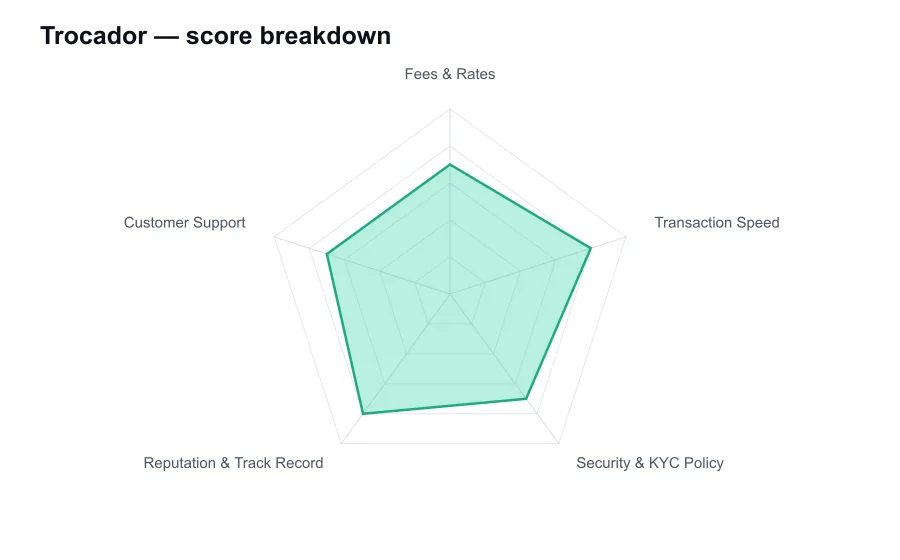
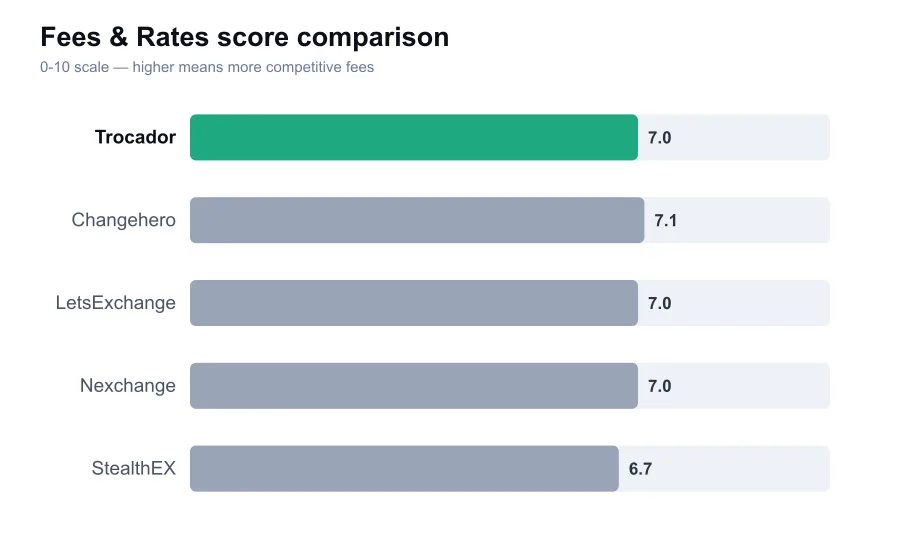
| Fees & Rates | 7.0 | 0.5% platform fee, offset by route comparison |
| Transaction Speed | 8.0 | Compares partner estimates and fast routes |
| Security & KYC Policy | 7.0 | No standing custody and visible KYC route signals |
| Reputation & Track Record | 8.0 | Operating since 2019 with a known aggregator role |
| Customer Support | 7.0 | Can mediate partner cases, but lacks final control |
| Fact | Value |
|---|---|
| Founded | 2019 [source] |
| Platform fee | 0.5% [source] |
| Service model | Instant-exchange aggregator [source] |
| Rate options | Fixed and floating routes [source] |
| Account model | No standing exchange account [source] |
| Partner information | Provider ratings and KYC indicators [source] |
What is Trocador?
How Trocador Works
- Choose the asset you are sending and receiving
- Compare listed providers, payout amounts and route details
- Select a fixed-rate or floating-rate offer if available
- Enter your receiving wallet address
- Send the deposit to the selected provider's address
- Use the exchange ID and transaction hash to track the swap
KYC
| Requirement | optional |
|---|---|
| Notes | Trocador itself is built around low-friction swaps and shows KYC-related partner information. The selected provider can still request verification or source-of-funds information after screening. |
Supported Assets
| Notable coins | Bitcoin, Ethereum, Monero, Tether, USD Coin, Litecoin, Solana, Dash |
|---|---|
| Networks | Bitcoin, Ethereum, Tron, Solana, BNB Smart Chain |
How to Use Trocador Safely
- Read the selected provider's rating before choosing the best quote
- Check whether the route is fixed-rate or floating-rate
- Confirm the recipient wallet supports the asset and network
- Save the provider name, exchange ID and deposit hash
- Use a test transaction before sending a large amount
Review Summary
Trocador is one of the more interesting names in the instant-exchange category because it is primarily an aggregator rather than a single exchange desk. The site compares offers from multiple third-party swap providers, then lets the user select a route based on output, speed, rating and whether a partner may ask for verification. That makes it closer in spirit to a price-comparison layer for instant exchanges than to a conventional centralized exchange. It is especially popular among Bitcoin and privacy-minded users who want to avoid maintaining an account with a large custodial platform.
Its central idea is sound. Instant exchangers often quote noticeably different outcomes for the same transaction because they use different liquidity sources, have different spreads and price blockchain fees differently. Trocador puts several of those offers in one place. A user converting BTC to XMR, for example, can see that the best nominal output is not always the best practical choice if the provider has a poor user rating, a long estimated time or a higher likelihood of compliance checks. This is a more useful decision framework than simply choosing the first exchange result found through a search engine.
Trocador generally charges a 0.5% platform fee on top of the selected provider's quote. That is the clearest drawback. A direct exchange with the same partner may sometimes be cheaper, and a deep order-book venue will often beat it on highly liquid pairs. The fee is the price of aggregation, partner monitoring and support involvement. Whether that price is acceptable depends on the transaction. For someone making a small, infrequent conversion, the ability to compare routes can easily justify it. For someone repeatedly trading BTC and USDT, it adds up quickly.
The effective cost is still more complicated than 0.5%. Each partner has its own spread, and the selected network can dominate the cost of a smaller transaction. Bitcoin miner fees, Ethereum gas, token transfer fees and the liquidity available for a particular pair all feed into the final amount. Trocador deserves credit for showing comparison results rather than pretending every route is identical. Yet users should focus on the final amount delivered, not the stated percentage. A route with a lower service fee can still pay less after the provider's spread has done its work.
The service gives users a useful amount of control over execution. Results can be filtered by rate type, and the exchange options distinguish fixed-rate offers from floating-rate offers where supported. It also provides KYC-related information for partner services, allowing a user to avoid routes that are known to require verification in normal circumstances. That is a practical feature, not an absolute guarantee. A provider can still stop a transfer if its controls identify risk. Trocador has been clearer about that limitation than many services that advertise themselves as anonymous without qualification.
Speed depends almost entirely on the chosen partner and the blockchains involved. This is not a weakness unique to Trocador, but it does mean its own role is often misunderstood. Trocador does not take possession of every transaction and manually exchange it from a central pool. It directs the user to a selected provider's exchange flow. A fast Tron stablecoin route may settle quickly, while a Bitcoin deposit with several required confirmations can take much longer. The quoted estimate is helpful, but never treat it as a contractual settlement guarantee.
Trocador's reputation is stronger than most smaller instant-exchange brands because it has been operating since 2019 and has built a recognizable identity around comparison, privacy and public partner information. It is particularly well known among users who transact in Monero and among people who dislike the account-first approach of large exchanges. Longevity does not eliminate risk, but it matters. A service that has handled years of user reports, changing partner availability and difficult support cases has more evidence behind it than a newly launched swap site with a slick landing page.
The provider-rating system is one of Trocador's best decisions. Aggregators can otherwise create a dangerous illusion that every listed partner has the same standard. Trocador gives users signals about exchange quality and has removed or restricted partners when its own assessment warrants it. That is not the same as an independent financial audit, and users should not mistake a site rating for insurance. Still, it is a more responsible approach than sending a user to an opaque route with no visible explanation of who is processing the transfer.
There is a hard privacy reality behind the product. Trocador can help a user choose providers that do not require routine verification, but it cannot exempt transactions from anti-money-laundering controls used by underlying partners. If an exchange flags funds, requests source-of-funds evidence or decides it cannot process a transaction, Trocador can advocate and coordinate but may not have final control over the assets. This is the key limitation of its model. The aggregator's support quality matters greatly, yet the selected exchange remains a counterparty risk.
Security is therefore a mix of strengths and constraints. Trocador does not require users to leave a balance in a hosted account, and direct wallet payout reduces the temptation to keep assets sitting on an exchange. It also provides more route-level information than many competitors. But a swap remains a temporary custodial handoff to the third-party provider. If you are exchanging a serious amount, check the partner name, read the displayed terms, choose fixed rate if price certainty matters and retain every transaction record. That discipline is more useful than trusting a privacy-oriented brand slogan.
Support has a better reputation than one would expect from a comparison service. Trocador provides direct support and acts as an intermediary when a partner swap is delayed or disputed. Its public-facing posture has helped it win goodwill in communities where users care deeply about transparent communication. There are limits, though. Support cannot make a blockchain confirm faster, and it cannot force a partner to ignore a compliance flag. A user who starts with a clear deposit hash, exchange ID and screenshots of the route will have a much easier time getting useful assistance.
The interface is functional rather than glamorous. That is not a criticism. It puts the relevant information in front of the user: expected output, rate type, estimated duration, provider and verification signals. The tradeoff is that newcomers can find the number of choices intimidating. A beginner may be tempted to select the highest payout without reading the provider details. That is exactly the wrong approach. The most suitable route is usually a balance of price, track record, rate lock and a network you can receive safely.
Trocador is not the cheapest place to buy or sell crypto, and it is not meant to be. A trader who has completed identity verification and wants repeated exposure to BTC, ETH or stablecoins will usually get better execution at Kraken, Coinbase Advanced or Binance where permitted. Trocador earns its place for cross-asset swaps, privacy-conscious users and people who value route comparison. It is particularly useful when a conventional exchange does not support the asset pair you need, or when you want to move between wallets without opening another custodial account.
My verdict is positive, with a clear qualification. Trocador is among the more trustworthy instant-exchange aggregators because it makes partner choice visible rather than hiding it, and because its long operating history gives its support claims some weight. The 0.5% platform fee is a real cost, not a trivial footnote, so compare it against a direct provider and an order-book exchange before committing. For modest to medium wallet-to-wallet conversions, its convenience and route information are genuinely valuable. For high-frequency trading, very large transfers or situations where guaranteed regulatory clarity matters, use a licensed exchange or an OTC desk instead.
Pros & Cons
| Pros | Cons |
|---|---|
| Compares offers from multiple instant exchangers | — |
| 0.5% fee is clearly disclosed | — |
| Shows partner and KYC-related route information | — |
| Strong reputation among privacy-focused crypto users | — |
| Useful fixed-rate and floating-rate choices | — |
Frequently Asked Questions
What fee does Trocador charge?
Trocador generally charges a 0.5% platform fee. The final exchange cost can be higher because the chosen provider's quote, spread and blockchain network fees are also included.
Can Trocador help me avoid exchanges that normally request KYC?
Trocador displays KYC-related information and lets users compare partner routes, but no route can promise that verification will never be requested after a transaction is risk-flagged.
Does Trocador hold my crypto balance?
Trocador is an aggregator, not a conventional account-based exchange. The selected instant-exchange partner processes the swap, and the result is sent to the wallet address you enter.
Why is the highest Trocador quote not always the best choice?
A higher output can come from a provider with a weaker rating, a floating rate or a slower route. Check the partner, expected time, rate type and KYC indicator before choosing.
Can I use Trocador for Monero swaps?
Trocador is widely used for routes involving Monero, subject to partner availability at the time of the quote. Confirm that the destination wallet supports the exact asset and address format.
Who should I contact if a selected provider delays a swap?
Keep the exchange ID and deposit transaction hash, then contact Trocador support and the selected provider if instructed. Trocador can mediate, though the partner controls the actual swap.