| Best for | Published 0.25% service fee, Fixed-rate and floating-rate routes, No routine account registration, Non-custodial wallet-to-wallet flow, 24/7 customer support |
|---|---|
| Not for | Final price can differ from the headline fee, Risk screening can delay a transaction, No order-book trading or fiat account features |
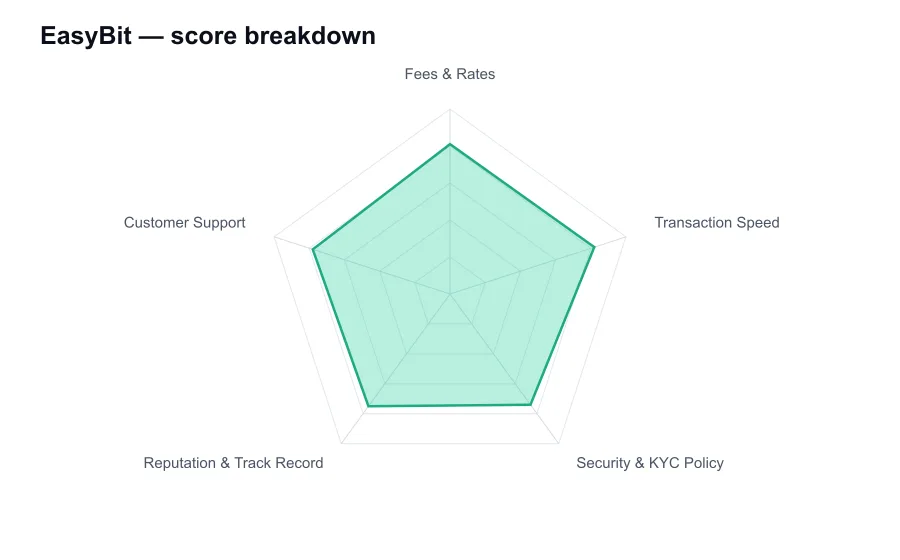
| Criterion | Score | Note |
|---|---|---|
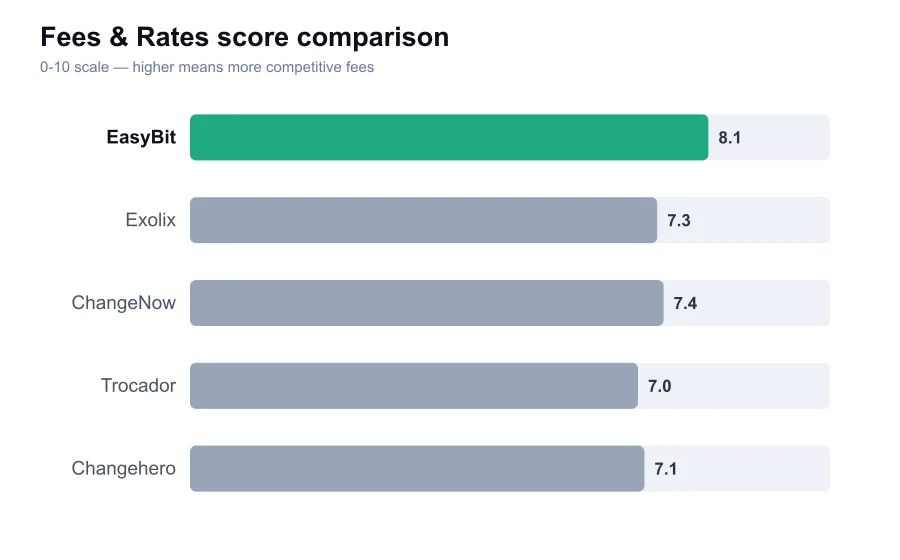
| Fees & Rates | 8.1 | Advertised 0.25% service fee, but compare final quotes. |
| Transaction Speed | 8.2 | Most mainstream swaps complete in minutes after confirmations. |
| Security & KYC Policy | 7.4 | Non-custodial flow, with possible AML review on flagged swaps. |
| Reputation & Track Record | 7.5 | Established instant-exchange brand, though not institution-scale. |
| Customer Support | 7.8 | 24/7 chat and email are useful for transaction-specific issues. |
What is EasyBit?
How EasyBit Works
- Choose the asset you are sending and the asset you want to receive
- Enter the amount and select a fixed or floating rate
- Provide and carefully verify your receiving wallet address
- Send the required amount to the generated deposit address
- Wait for blockchain confirmations and receive the converted asset
KYC
| Requirement | optional |
|---|---|
| Notes | Routine swaps generally do not require registration or identity documents. EasyBit may request verification for transactions flagged by AML or risk controls. |
Supported Assets
| Notable coins | Bitcoin, Ethereum, Tether, USD Coin, Solana, Litecoin, Monero |
|---|---|
| Networks | Bitcoin, Ethereum, Solana, Tron |
How to Use EasyBit Safely
- Bookmark easybit.com rather than using search ads
- Match the token network exactly before sending
- Run a small test before a large conversion
- Save the exchange ID and transaction hashes
- Compare the final receive amount with another quote
Review Summary
EasyBit is a non-custodial instant crypto exchange aimed at people who want to swap one asset for another without opening a conventional trading account. It sits closer to ChangeNOW, SimpleSwap, and StealthEX than to Binance or Kraken. You choose a pair, send crypto to a generated address, and receive the destination asset in a wallet you control. That simplicity is EasyBit's appeal, especially for users who already hold coins in a private wallet and don't need charts, order books, or margin trading.
The service has been around long enough to be more than an anonymous one-page swap widget, and that matters in this corner of crypto. EasyBit presents a recognizable brand, maintains public help material, and has a visible support presence. Still, it is a lightweight exchange service rather than a heavily supervised financial institution. You should judge it as an execution tool for occasional conversions, not a place to park a large portfolio or run a high-volume treasury operation.
Fees are one of EasyBit's stronger points, provided you understand how instant exchanges quote prices. The platform advertises a 0.25% service fee for crypto swaps. That sounds straightforward, and compared with several instant competitors that embed a wider spread with no published fee, it is refreshingly clear. The number does not tell the whole story, though. Liquidity-provider pricing, network fees, and the spread between quoted and executable rates can still affect the final amount you receive.
For a small BTC to ETH exchange, the practical question is not whether the headline fee is 0.25%. It is whether the estimated receive amount remains competitive after the network fee and rate spread are included. EasyBit's quote screen makes this easier to inspect than a service that conceals every component, but experienced users should still compare the output against a major exchange or a second instant exchanger before confirming a large order. A 0.25% platform fee can be fair while the all-in execution price is merely average.
EasyBit offers floating and fixed-rate exchange options. The floating route generally gives the market a chance to move until the provider receives and processes your deposit. The fixed-rate option is designed to reduce that uncertainty for the quoted window, though fixed quotations typically carry a slightly less favorable rate because somebody has to absorb price movement risk. For volatile pairs, fixed rate is the sensible choice if knowing the approximate outcome matters more than squeezing out every last fraction of a percent.
Speed is good for the kind of product this is. Once a deposit has enough confirmations and the partner liquidity route is available, many popular swaps finish within minutes. Bitcoin deposits can naturally take longer than swaps involving faster networks, and Ethereum congestion can make the process feel slow even when EasyBit is doing its part promptly. The weak point is inherent to all non-custodial instant exchangers, you cannot treat the displayed estimate as a guaranteed settlement time while a blockchain is waiting for confirmations.
EasyBit is best used with clean, mainstream routes. BTC, ETH, USDT, USDC, LTC, XMR, SOL and similar heavily traded assets are more likely to have reliable liquidity than an obscure token on a thin chain. Users sometimes assume that listing a token means every amount can be executed smoothly. It does not. A small or exotic swap can be affected by minimums, routing availability, wallet maintenance, or a changing destination address format. Check the exact network, especially for USDT and USDC.
On identity checks, EasyBit's ordinary flow does not require account registration or routine KYC. That does not mean every transaction is immune from review. Like most services that source liquidity and screen transfers, EasyBit can request verification when its risk controls flag a transaction. The distinction matters. No mandatory sign-up is convenient, but it is not a promise that an unusually large, sanctioned, stolen, or suspiciously routed transfer will proceed without questions.
The security model is better than a custodial exchange in one important respect, EasyBit does not need to hold your balance between trades. You send funds for a specific conversion and receive them back into an address you supplied. That sharply reduces the risk of leaving an account balance exposed to an exchange failure. It does not remove execution risk. If you enter a wrong destination address, choose the wrong network, or send less than the stated minimum, blockchain finality gives you little room to recover.
I would also avoid treating a non-custodial label as a substitute for due diligence. EasyBit processes the swap path and can rely on third-party liquidity providers. A temporary hold or a compliance question can still happen. Before using it for a meaningful amount, run a small test transaction. Save the exchange ID, the deposit address, the receiving address, and the transaction hash. Those details are what support will need if the expected payout does not arrive.
EasyBit's reputation is respectable for a mid-sized instant exchanger, though it does not have the institutional depth of Coinbase, Kraken, or Bitstamp. Public review sites contain many positive reports about fast exchanges, but that is normal for services where the average transaction ends quickly. More useful is how the company handles the occasional delayed order, rate issue, or compliance hold. Its support channels and public-facing presence are a positive, but they do not make customer risk disappear.
Support is available around the clock through live chat and email channels, which is a real advantage when a swap is waiting on a confirmation late at night. In routine cases, the support experience tends to be practical because agents can ask for the transaction hash and locate the order. Difficult cases are less pleasant. If a blockchain is congested or a risk review is involved, a chat agent cannot simply override the underlying process. Keep your expectations realistic and do not send an amount you cannot afford to have delayed.
The mobile experience is browser based rather than dependent on a dedicated app. That is fine for an instant swap, and it avoids the confusion of fake app listings, but it also means you should be especially careful with URLs. Bookmark the official site, do not follow sponsored lookalike links, and verify the domain before connecting a wallet or copying a deposit address. Phishing around instant exchange brands is common because users are often moving funds quickly.
My view is that EasyBit is a credible option for straightforward wallet-to-wallet swaps, particularly where a transparent 0.25% service fee and a fixed-rate choice matter. It is not the cheapest route for every pair, and it should not replace a regulated exchange for recurring fiat purchases or serious portfolio management. Compare quotes, use the correct network, and start small. Used that way, EasyBit does the job well and has a better balance of clarity and convenience than many smaller instant exchange sites.
Pros & Cons
| Pros | Cons |
|---|---|
| Published 0.25% service fee | — |
| Fixed-rate and floating-rate routes | — |
| No routine account registration | — |
| Non-custodial wallet-to-wallet flow | — |
| 24/7 customer support | — |
Frequently Asked Questions
What fee does EasyBit charge?
EasyBit advertises a 0.25% service fee. Your final receive amount can also reflect network fees, liquidity-provider pricing, and the difference between floating and fixed-rate quotes.
Does EasyBit require KYC?
Routine exchanges generally do not require account registration or KYC. EasyBit can request verification if its risk and AML controls flag a particular transaction.
What is the difference between EasyBit fixed and floating rates?
A floating-rate exchange settles using the market rate available during processing. A fixed-rate quote is intended to protect the quoted outcome for its stated time window, usually at a less favorable price.
Why is my EasyBit swap taking longer than expected?
The most common causes are deposit confirmations, a busy destination network, wallet maintenance, limited liquidity, or a transaction requiring additional review. Keep the exchange ID and transaction hash for support.
Can I send USDT from any network to EasyBit?
No. USDT exists on multiple networks. Select the exact network shown in the order and send only that version. Sending an unsupported version to a deposit address can be difficult or impossible to recover.
Should I use EasyBit for a large exchange?
For a meaningful amount, compare the final quote with another service and send a small test first. Check the minimum, the destination network, and whether the rate is fixed before funding the order.