| Best for | Established operator since 2017, No routine registration for basic swaps, Fixed-rate and floating-rate options, 24/7 customer support, Wallet, API, and business integrations |
|---|---|
| Not for | Rates can be weaker than liquid spot markets, Compliance checks can hold an order, Not a full-featured trading exchange |
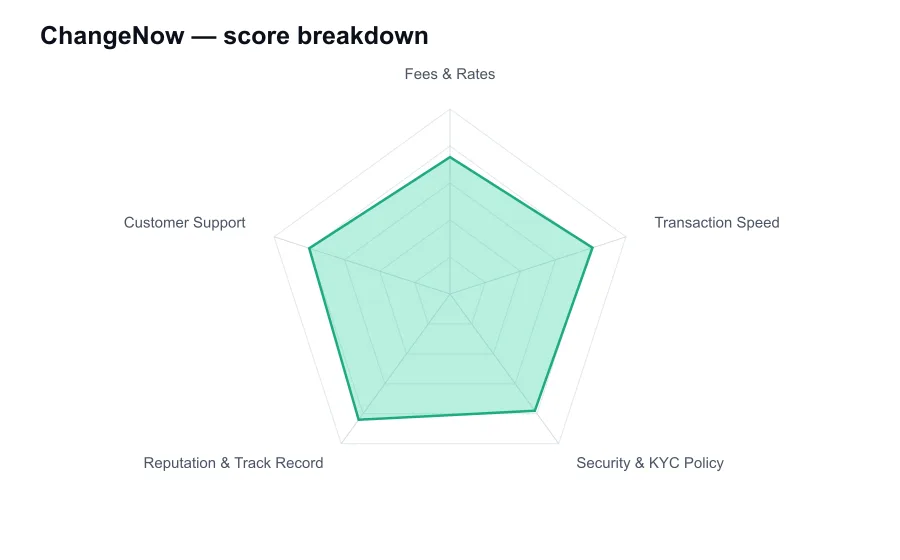
| Criterion | Score | Note |
|---|---|---|
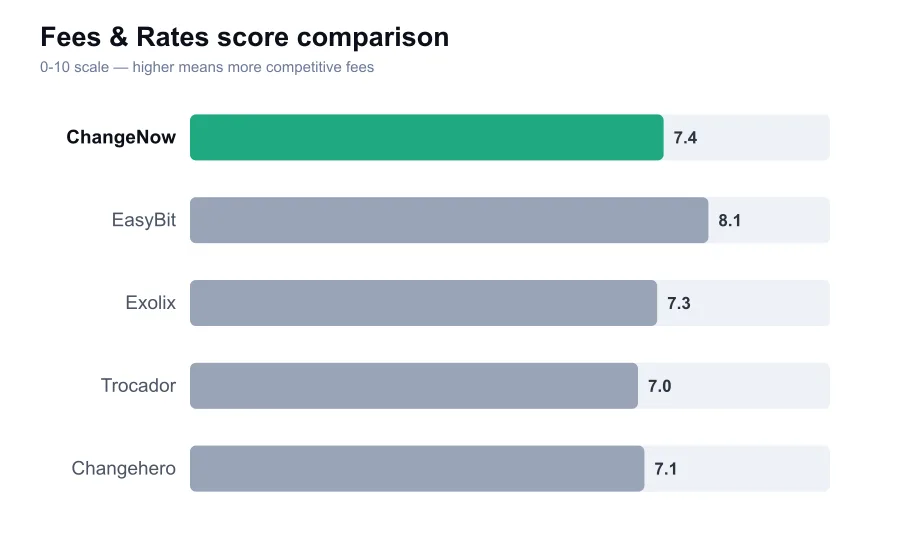
| Fees & Rates | 7.4 | Fees start from 0.5%, with the final output driving value. |
| Transaction Speed | 8.1 | Most routine swaps finish in minutes after confirmation. |
| Security & KYC Policy | 7.8 | Established non-custodial model with risk screening. |
| Reputation & Track Record | 8.4 | Operating since 2017 with a substantial public footprint. |
| Customer Support | 8.0 | 24/7 chat and email support plus order-status tools. |
What is ChangeNow?
How ChangeNow Works
- Choose the cryptocurrency pair and transaction amount
- Pick a floating or fixed-rate quote
- Enter a destination wallet address
- Send the deposit to the displayed address
- Use the order page to follow confirmations and payout
KYC
| Requirement | optional |
|---|---|
| Notes | Basic exchanges typically do not require registration or routine identity checks. ChangeNOW can request verification where compliance systems identify elevated risk. |
Supported Assets
| Notable coins | Bitcoin, Ethereum, USDT, USDC, Solana, BNB, XRP, Litecoin, Dogecoin, Monero |
|---|
How to Use ChangeNow Safely
- Compare the final output with another exchange before confirming
- Choose fixed rate if you need a precise received amount
- Verify token contract and network, especially for stablecoins
- Keep the exchange ID and both transaction hashes
- Start with a test transaction for a new wallet or network
Mobile App
| iOS app | Yes |
|---|---|
| Android app | Yes |
| Notes | NOW Wallet is ChangeNOW's mobile wallet product for iOS and Android. |
Review Summary
ChangeNOW is one of the best known instant cryptocurrency exchange services. Founded in 2017, it built its name around a simple offer: swap assets from a personal wallet without creating a conventional trading account. It has since expanded into a broader product family that includes NOW Wallet, business tools, an API, a Pro offering, and its own NOW token. The core swap service remains the reason most people encounter it.
Its place in the market is clear. ChangeNOW is more established and more polished than many small anonymous instant exchangers, but it is not a substitute for a major centralized exchange with an order book, fiat rails, and deep regulatory disclosures. It is a convenience layer between wallets and liquidity sources. That distinction matters, particularly when users are deciding whether to exchange fifty dollars or fifty thousand.
The primary advantage is the flow. A user chooses the asset pair, enters a receiving address, reviews the quote, sends the deposit, and receives the output. There is no need to set up two-factor authentication just to make a single conversion, and there is no permanent hosted balance to leave behind after the swap. For a self-custody user, that feels considerably cleaner than registering at a traditional exchange.
Fees are not presented like a classic maker and taker schedule because ChangeNOW generally incorporates its service economics into the quoted rate. The company has stated that it charges a service fee from 0.5 percent, with network fees and liquidity costs affecting the final result. That can be straightforward for a casual user, but it makes disciplined comparison essential. The received amount is more meaningful than any headline fee.
For major pairs, ChangeNOW is often reasonably competitive with other instant exchangers. It is less likely to beat a deep spot market after a user accounts for spread, especially if the user already has access to a low-fee trading venue. The fee for convenience is real. A buyer who makes one occasional wallet swap may barely care. A user who converts assets every week should care a great deal, because rate differences compound.
ChangeNOW offers floating-rate and fixed-rate exchanges. A floating order may produce more output if the market moves favorably while the deposit is confirming, but it can also produce less. A fixed order protects the specified output during the rate-lock period, subject to the service's terms and the user sending the correct amount on time. For volatile assets or payment-sized conversions, I prefer fixed pricing despite the cost.
Speed is generally a strength. ChangeNOW states that most exchanges are completed in a few minutes, and routine transactions on fast networks can indeed be quick. Yet a promise of fast swapping should not be confused with guaranteed fast settlement. Bitcoin confirmation times, Ethereum congestion, a low-fee source transaction, unavailable liquidity, and destination-chain maintenance can all extend the process. The right expectation is fast processing after valid confirmation, not instant magic.
The provider's security posture is stronger than most no-account swap sites because it has spent years operating at scale and has invested in public-facing policies and product development. It remains non-custodial in the narrow sense that customers do not maintain a trading balance on ChangeNOW. During the transaction itself, the service receives and transfers assets. A user is exposed to ChangeNOW and its liquidity infrastructure for that window, so the model is safer than leaving funds on an exchange but not equivalent to a peer-to-peer atomic swap.
No routine KYC is a central part of ChangeNOW's pitch. Still, its risk policy permits additional checks where anti-money-laundering systems identify suspicious activity. That can include a request for documents, source-of-funds information, or other explanations before an order is released. Some users regard that as a contradiction, but it is simply how nearly every sizable instant exchanger now operates. The mistake is assuming a no-registration workflow creates a guarantee against a compliance hold.
Reputation is ChangeNOW's strongest category. It has operated since 2017, maintained an active public profile, built partnerships and integrations, and survived several difficult years for crypto service providers. That is meaningful. It does not put the company beyond criticism. Like other instant exchangers, it receives complaints from users whose orders were delayed, repriced, or screened. The fair question is whether the service is visible enough, reachable enough, and experienced enough to resolve those cases. Compared with obscure swap sites, the answer is much more often yes.
Customer support is available 24 hours a day through live chat and email, and ChangeNOW also has an exchange-status mechanism users can consult. That coverage is valuable because a customer might send a transaction at any hour. The quality of support still varies with the complexity of the issue. A simple delayed confirmation is easier to solve than a compliance case or a deposit sent on the wrong network. Users should keep every technical detail rather than relying on memory.
ChangeNOW's wider product set can either be a benefit or a distraction. NOW Wallet gives users a mobile option, while the API and white-label tools serve businesses that want instant exchange functionality in their own products. These additions make ChangeNOW more credible as an operating business than a single-page swap site. They do not automatically make every quote the best price. Product breadth and execution quality are different things.
It is a good fit for someone moving between supported crypto assets from a personal wallet, especially if avoiding a new exchange account is a priority. It can also make sense for travel, emergency rebalancing, or converting an asset held in an awkward chain. It is not suitable for users seeking leveraged trading, limit orders, fiat withdrawals, proof-of-reserves reporting, or bank-grade dispute procedures.
I rate ChangeNOW as one of the better general-purpose instant exchangers, with the caveat that it should be used for what it is. Its reputation, support availability, broad integrations, and predictable flow are clear advantages. Its rates will not always be the best, and its compliance system can still interrupt a transaction. For normal self-custody swaps, it is a reliable first quote to check. For a large or urgent conversion, compare the output against at least one competitor and send a test amount first.
Pros & Cons
| Pros | Cons |
|---|---|
| Established operator since 2017 | — |
| No routine registration for basic swaps | — |
| Fixed-rate and floating-rate options | — |
| 24/7 customer support | — |
| Wallet, API, and business integrations | — |
Frequently Asked Questions
What does ChangeNOW charge for a swap?
ChangeNOW states that its service fee starts from 0.5%. The actual cost is reflected in the quoted output and can also include liquidity spread and blockchain network fees.
Does ChangeNOW require KYC?
Routine swaps do not normally require account verification. ChangeNOW may request KYC or source-of-funds information when its compliance systems flag a transaction.
How long does a ChangeNOW exchange take?
ChangeNOW says most exchanges are completed in a few minutes. The real timing depends on source-chain confirmations, congestion, asset liquidity, and destination-network conditions.
What is the difference between fixed and floating rates on ChangeNOW?
Fixed-rate orders aim to preserve the displayed output during the quote window. Floating orders settle at the market rate after the deposit is processed, so the received amount can move.
Can ChangeNOW hold funds for compliance review?
Yes. Its no-routine-KYC model does not prevent risk controls. A transaction linked to suspicious activity can be paused while the company requests additional information.
Does ChangeNOW have products beyond instant swaps?
Yes. Its product family includes NOW Wallet, NOW Token, an exchange API, and business-oriented integration tools in addition to the consumer swap service.
Is ChangeNOW a decentralized exchange?
No. It is a non-custodial instant exchange service. Users do not hold a standing account balance there, but funds pass through the service during an active conversion.