| Best for | Published 0.5% floating-rate fee, Fixed-rate swaps for volatile markets, No account needed for normal exchanges, Fast automated transaction flow |
|---|---|
| Not for | Linked to a roughly $26 million 2024 exploit, No insurance or protected customer balances, Support is limited for complex disputes |
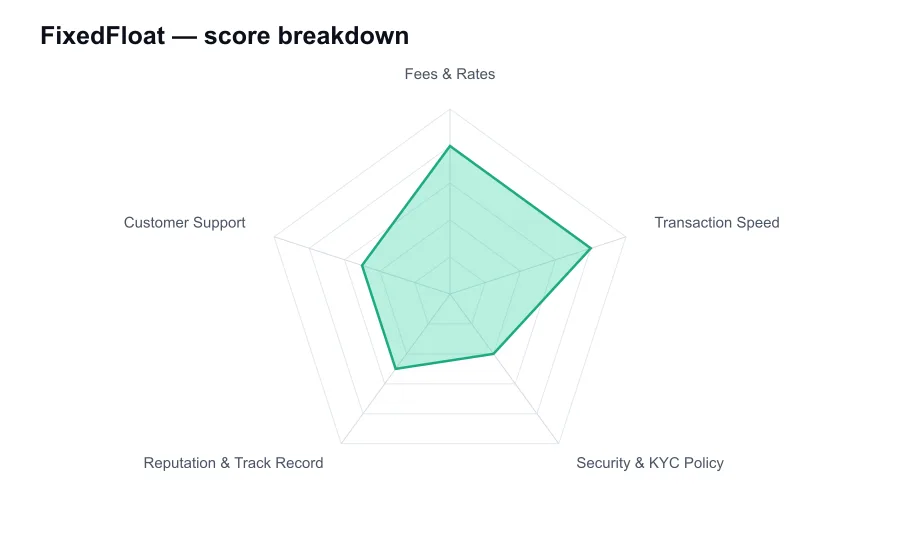
| Criterion | Score | Note |
|---|---|---|
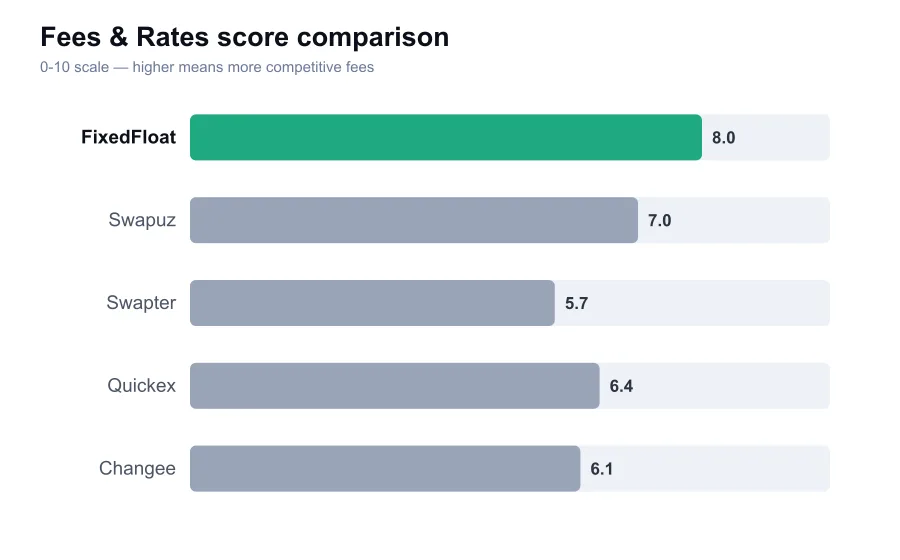
| Fees & Rates | 8.0 | 0.5% floating or 1% fixed fee, plus network costs |
| Transaction Speed | 8.0 | Automated swaps often finish minutes after confirmations |
| Security & KYC Policy | 4.0 | No routine KYC, but a major 2024 security incident matters |
| Reputation & Track Record | 5.0 | Established service, though the 2024 exploit damaged confidence |
| Customer Support | 5.0 | Chat-based help is adequate for routine swap issues |
What is FixedFloat?
How FixedFloat Works
- Choose the asset and network you want to send
- Choose the asset and network you want to receive
- Select a floating or fixed-rate quote
- Enter and verify the receiving wallet address
- Send the exact requested amount to the generated address
- Track the exchange using the order ID
KYC
| Requirement | optional |
|---|---|
| Notes | FixedFloat historically allows normal swaps without registration or routine KYC. It can request information or documents where its compliance controls flag a transaction. |
Supported Assets
| Notable coins | Bitcoin, Ethereum, Litecoin, Monero, USDT, USDC, Solana |
|---|---|
| Networks | Bitcoin, Ethereum, Tron, BNB Smart Chain, Polygon |
How to Use FixedFloat Safely
- Test a new route with a small amount first
- Match the token network exactly before sending
- Save the exchange ID and transaction hash
- Do not use an exchange deposit address as a long-term wallet
- Use a fixed quote only if you can send within its time window
Review Summary
FixedFloat is a non-custodial instant crypto exchange built for people who want to swap coins quickly without opening a conventional trading account. It has long appealed to Bitcoin users, privacy-minded holders, and people moving between chains who don't need charts, order books, or a portfolio dashboard. The service sits closer to ChangeNOW and SimpleSwap than to a centralised exchange such as Kraken or Coinbase.
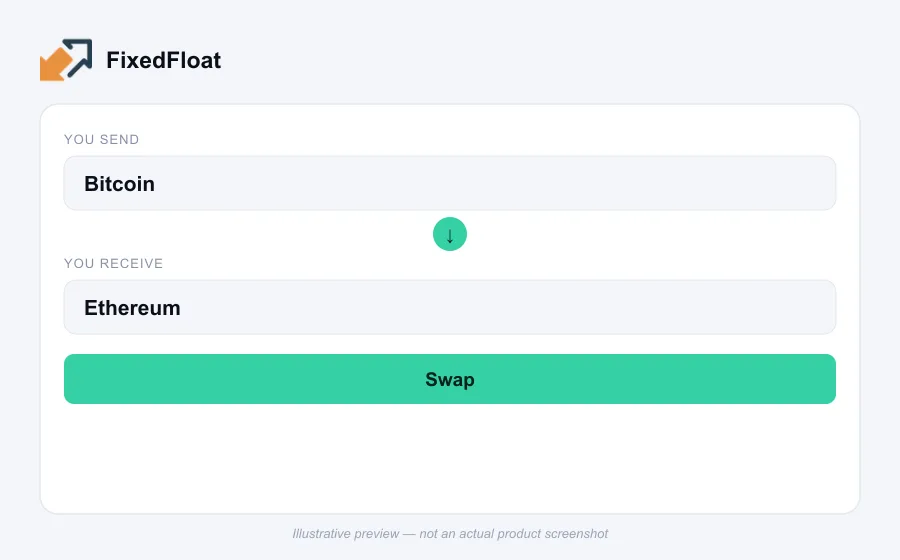
The appeal is obvious from the first screen. Pick the asset you are sending, select the asset you want to receive, enter a destination address, and FixedFloat generates a deposit address. There is no account requirement for a normal swap. That stripped-back workflow is refreshing if you already know exactly what you are doing, although it gives newcomers fewer opportunities to catch an expensive error before money leaves their wallet.
FixedFloat offers two pricing modes. Its floating-rate option charges a published 0.5% service fee plus the relevant network fee. The fixed-rate option charges 1% plus the network fee, with the displayed rate protected for the quoted exchange window. Those numbers are clear and, compared with many instant-exchange sites that bury their margin in a rate, relatively easy to understand.
The 0.5% floating fee is competitive, but it isn't necessarily the full economic cost of a swap. The exchange rate includes liquidity conditions, and network fees can be meaningful during busy periods. A small Bitcoin transaction can look cheap until the miner fee is added. Users should compare the actual amount received against a live quote from a liquid venue or another swap service rather than judging FixedFloat only by the headline percentage.
The fixed-rate option is the reason many regular users came to FixedFloat. During a volatile market, knowing the quoted amount should remain intact is useful, especially for BTC-to-stablecoin or ETH-to-BTC conversions. Still, the quote has a time limit. If the deposit arrives late, arrives short, or arrives on the wrong network, the promised rate may no longer apply. FixedFloat is fast, not forgiving.
For routine swaps, the service can be genuinely quick. Exchanges of assets with fast confirmations and available liquidity often complete within minutes after the deposit confirms. Bitcoin and congested Ethereum transactions naturally take longer, and an instant-exchange interface cannot make blockchain finality disappear. The practical speed depends first on the chain you send from, then on FixedFloat's liquidity provider route.
Its automated nature is a strength until an exception occurs. A standard exchange needs little human involvement, which is why FixedFloat can process simple transfers rapidly. But an underpayment, a token sent via an unsupported chain, or an AML review can move the case outside that fast path. At that point, a customer is dealing with a support queue rather than a smooth machine.
Security is where FixedFloat requires a more cautious reading than its neat website suggests. It is non-custodial in the limited sense that it does not hold a standing account balance for the customer. Yet it takes possession of the funds during the swap. That means users still face counterparty risk for the duration of the transaction, and they should never treat a temporary exchange address as if it were a self-custody wallet.
FixedFloat has historically advertised no registration and no routine KYC. That is attractive to users who don't want to upload identity documents for a small conversion. It does not mean every transaction is guaranteed to be anonymous or free from review. Its terms allow compliance checks and requests for information in suspicious cases. Anyone whose funds have complicated provenance should understand that a no-sign-up service can still pause a transaction.
The biggest shadow over FixedFloat is the February 2024 security incident. Blockchain investigators linked suspicious outflows from FixedFloat-controlled wallets to thefts estimated at roughly $26 million, involving Bitcoin, Ethereum, Tether, and other assets. The service temporarily suspended operations. A serious incident does not automatically prove that every user was harmed or that the platform cannot operate safely afterward, but it is a major reputational fact, not a footnote.
That event changes how I would use the service. FixedFloat had built a strong reputation for speed and a simple fixed-rate product before the exploit. After a loss on that scale, trust has to be earned through sustained transparent operation, not assumed because the interface is familiar. I would not park funds there, split a large swap into smaller test transactions, and avoid using it for an amount that would be painful to have delayed.
Support is functional but not a standout reason to choose the platform. FixedFloat offers an on-site chat channel and support contact routes, and routine transaction questions can be addressed with a swap ID. The hard cases are where support matters most, and public feedback has been mixed around delayed or compliance-flagged swaps. There is no phone desk, dedicated account manager, or formal protection comparable to a regulated exchange's customer-service structure.
Asset support is broad enough for most mainstream swapping needs, including Bitcoin, Ethereum, Litecoin, Monero, and major stablecoins. Network selection deserves special care. USDT on Ethereum, Tron, BNB Smart Chain, Polygon, and other routes are different assets operationally, even where the ticker looks identical. A wrong network selection is one of the easiest ways to turn a five-minute exchange into a support case.
FixedFloat still has a clear use case: a technically competent user who values a quick, account-free exchange and is comfortable checking every detail independently. Its transparent published fee tiers remain better than vague all-in spreads, and its fixed-rate route is useful. The 2024 incident prevents me from calling it a low-risk default. Use it as a transaction tool, not as a trusted home for capital.
Pros & Cons
| Pros | Cons |
|---|---|
| Published 0.5% floating-rate fee | — |
| Fixed-rate swaps for volatile markets | — |
| No account needed for normal exchanges | — |
| Fast automated transaction flow | — |
Frequently Asked Questions
What does FixedFloat charge?
FixedFloat publishes a 0.5% service fee for floating-rate exchanges and 1% for fixed-rate exchanges. Both options also include the applicable network fee.
Does FixedFloat require KYC?
Normal swaps have historically required no account or routine KYC. Its terms allow compliance checks and requests for information for transactions flagged as suspicious.
What happened to FixedFloat in 2024?
In February 2024, blockchain investigators linked suspicious outflows from FixedFloat wallets to thefts estimated at roughly $26 million. The service temporarily suspended operations.
How long does a FixedFloat swap take?
Many swaps complete within minutes after the deposit receives enough blockchain confirmations. Bitcoin congestion, Ethereum gas conditions, and manual reviews can make a transaction take longer.
What is the difference between fixed and floating rates?
A fixed-rate swap is quoted with a protected rate for the stated time window and has a 1% fee. A floating-rate swap uses the market rate at execution and has a 0.5% fee.
Can I send USDT on any network?
No. You must select the exact network shown in the quote. USDT on Ethereum, Tron, BNB Smart Chain, and Polygon use different transfer routes.