| Best for | Straightforward wallet-to-wallet exchange flow, No standing trading account for normal swaps, Useful for small one-off major-asset conversions, Avoids the complexity of an order-book terminal |
|---|---|
| Not for | Limited public track record and corporate transparency, No clear published maker and taker fee schedule, Possible KYC review despite low-friction onboarding, Not suitable for large or time-critical transfers |
| Criterion | Score | Note |
|---|---|---|
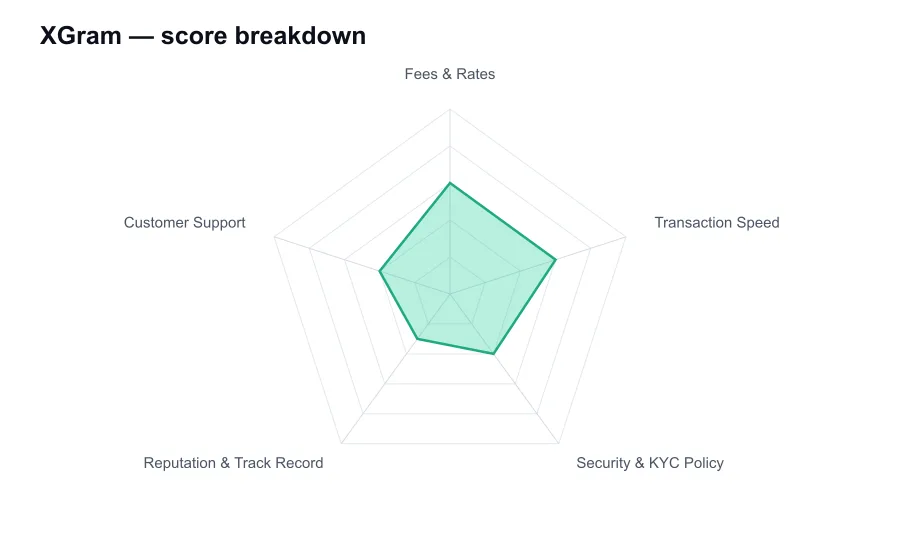
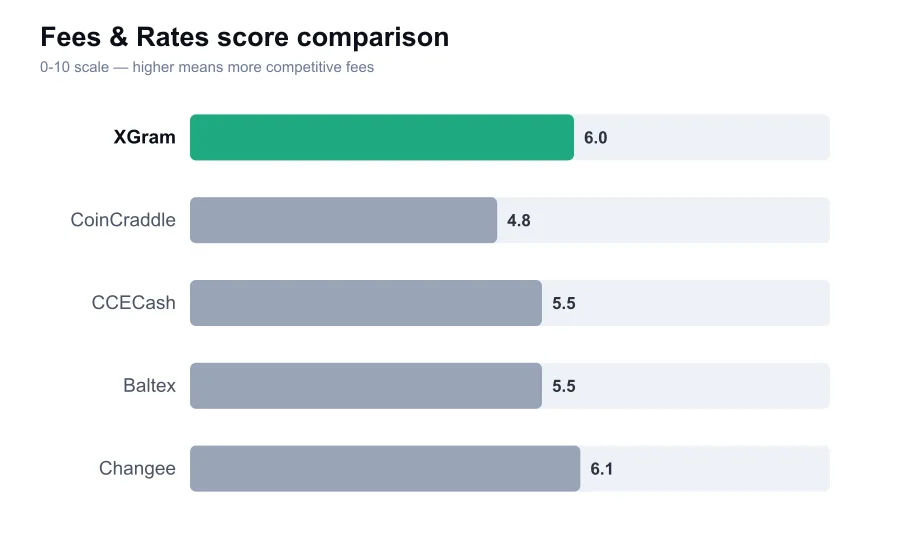
| Fees & Rates | 6.0 | Quotes are convenient, but embedded spread is hard to audit |
| Transaction Speed | 6.0 | Standard instant-swap timing, chain conditions decide much |
| Security & KYC Policy | 4.0 | Wallet payout model, limited public security disclosure |
| Reputation & Track Record | 3.0 | Thin independent track record versus established rivals |
| Customer Support | 4.0 | Website support exists, limited public escalation evidence |
| Fact | Value |
|---|---|
| Service model | Instant cryptocurrency exchange |
| Account model | No routine trading account |
| Settlement | Direct payout to user wallet |
| Fee model | Quote-based, spread may apply |
| Verification policy | Possible for compliance review |
What is XGram?
How XGram Works
- Select the asset and network you want to send
- Choose the asset and network you want to receive
- Enter and verify the destination wallet address
- Review the quoted output and any transaction conditions
- Send the deposit to the generated address
- Keep the order ID and track the payout
KYC
| Requirement | optional |
|---|---|
| Notes | The ordinary exchange flow may not require account registration. Compliance screening can still result in a request for identity, source-of-funds or transaction-purpose information. |
Supported Assets
| Notable coins | Bitcoin, Ethereum, Tether, USD Coin, Litecoin, Solana |
|---|---|
| Networks | Bitcoin, Ethereum, Tron, Solana, BNB Smart Chain |
How to Use XGram Safely
- Compare the final payout against at least two alternatives
- Confirm the exact token network before depositing
- Use a small test amount on an unfamiliar route
- Keep the order ID, deposit hash and screenshots
- Do not use an old deposit address from a previous order
Review Summary
XGram is an instant cryptocurrency exchange service built around a familiar promise: convert crypto quickly without having to use a conventional account-based trading platform. It targets users who want a direct wallet-to-wallet swap, usually with a short form, a generated deposit address and a payout sent to a destination wallet. That puts it in competition with a crowded group of instant exchangers rather than with large venues such as Coinbase, Kraken or Binance. The problem for XGram is not that the model is unfamiliar. It is that this part of the market rewards history, transparency and support evidence, areas where smaller services have to work much harder to earn confidence.
The basic flow is simple enough for a first-time user. Select what you are sending, select what you want to receive, enter the destination address and send funds to the quoted deposit address. The exchange then relies on internal or third-party liquidity to deliver the chosen asset. This can be convenient for moving between self-custody wallets, particularly if the pair is unavailable on your normal exchange. It should never be mistaken for a decentralized exchange. The user still sends funds to an intermediary during processing and must trust that intermediary to settle correctly.
Pricing is the first area where users should be skeptical. XGram, like many instant exchangers, presents an expected output rather than a clear maker and taker fee schedule. The price can include a spread, liquidity-provider charge, mining fee allowance and service margin. That does not automatically make the service expensive. On some major pairs, the quote may be perfectly competitive. But it makes claims about low fees difficult to verify in the abstract. The only meaningful comparison is the number of coins you will receive after all costs, checked against another instant exchanger and a liquid centralized exchange.
For small swaps, network fees can overwhelm any difference in service pricing. An Ethereum mainnet transfer for a modest amount may be a poor decision regardless of which instant exchanger is used. Stablecoins make this particularly easy to get wrong because USDT and USDC exist on multiple networks. A quote for a Tron token is not interchangeable with a quote for an Ethereum token. XGram users should verify both the deposit network and the payout network before confirming. A correct asset ticker with an incorrect chain can turn a convenient exchange into a costly recovery problem, if recovery is possible at all.
The advertised speed of an instant swap is only partly under XGram's control. A fast network and an immediately available liquidity route can result in a fairly quick payout. Bitcoin deposits need confirmations, Ethereum may face gas congestion, and some assets have wallet maintenance periods at liquidity partners. These are normal operational limits. The concern is how clearly they are communicated when they occur. Smaller exchange services often look fast while everything is normal, then become difficult to assess during a delayed transaction because they have less extensive public status information and fewer established escalation channels.
XGram's no-account style is attractive to users who do not want to register for another exchange just to make one conversion. In a normal transaction, a user can often proceed by supplying wallet details rather than uploading documents upfront. That should not be read as a permanent no-KYC guarantee. Instant exchange providers are subject to internal compliance policies and often rely on partners with their own blockchain monitoring rules. A transaction can be held for review and users can be asked to provide identification or explain the source and purpose of funds. Anyone for whom that possibility is unacceptable should not send funds first and ask questions later.
There is a meaningful difference between minimizing data collection and having no counterparty risk. XGram may reduce the amount of routine personal information needed to initiate a swap, but the service still has access to transaction metadata and a temporary role in moving funds. The deposit and withdrawal addresses are public blockchain information, and the exchange can associate them with an order. Users who need stronger privacy should understand the legal and technical limits of any centralized instant-swap provider. Good wallet hygiene and lawful use matter more than marketing language about anonymity.
Security information is another area where XGram does not yet inspire the same confidence as long-running competitors. A non-custodial settlement model is preferable to keeping a permanent balance at a small exchange, and it reduces one obvious risk. But it does not tell you much about internal wallet controls, liquidity-provider selection, incident response, business ownership or the security review of the website itself. Major exchanges have their own failures, of course, but they tend to publish more about licensing, security architecture, proof of reserves or historical incidents. XGram offers less material for an independent user to evaluate.
That thin public record feeds into its reputation score. XGram may work properly for many users, but it has a much lighter independent track record than established instant-exchange brands such as Trocador, ChangeNOW or Changelly. A newer or less documented provider has to be approached differently. Search for recent user experiences, inspect the terms before depositing and test the actual route with an amount you can afford to have delayed. This is not paranoia. It is the sensible way to use an irreversible payment system where a support dispute can become the only route to recovering funds.
Support is where a small provider either earns repeat users or loses them. A standard completed order needs little help, so a polished homepage tells you almost nothing. The important test is a late payout, an underpaid floating-rate trade, a mismatched amount or a compliance hold. XGram provides a support channel through its website, but its public support footprint is less extensive than a larger exchange with formal ticketing, phone support or a mature public help center. Keep the order ID, deposit hash and screenshots from the moment you initiate an exchange. They are your evidence if the quote needs to be reconstructed.
The site's simplicity is a benefit, but it also means users need to supply their own caution. Check the payout address character by character, especially for long EVM addresses. Confirm whether the service expects a memo, destination tag or payment ID for assets that use them. Don't send an amount below a displayed minimum, and do not send extra funds to an old deposit address from a previous order. These are basic practices, yet they account for many avoidable support cases across the instant-exchange sector.
XGram is most defensible for a small, uncomplicated conversion involving a major asset on a familiar network. It can be useful if its quote is clearly better than alternatives and you have verified that the destination wallet supports the route. It is much less compelling for a first large purchase, a time-sensitive transfer, a privacy-critical transaction or an exchange involving a rare token. In those situations, the limited public history and less-developed transparency become material disadvantages. Convenience is only valuable when the risk of disruption is proportionate to the amount being moved.
The service also does not offer the advantages that make a centralized exchange worthwhile for frequent traders. There is no visible depth chart, no advanced order types, no published maker and taker tiers, and no reusable trading balance designed for rapid execution. That is not a defect if all you need is a single swap. It does mean users should compare XGram with the correct alternatives. It competes with other instant exchangers on quote quality and ease of settlement, not with an order-book exchange on professional trading infrastructure.
My take is cautious rather than hostile. XGram has the right basic product for users who need a direct crypto conversion and do not want another custodial account, but it has not earned the same level of confidence as the category's more established names. Its pricing has to be judged order by order, and its no-registration flow still carries the possibility of a compliance review. I would consider it for a small test swap after checking the exact route and payout. For large sums, important deadlines or regular trading, choose a provider with a longer public record, clearer fee disclosure and more demonstrable support capacity.
Pros & Cons
| Pros | Cons |
|---|---|
| Straightforward wallet-to-wallet exchange flow | — |
| No standing trading account for normal swaps | — |
| Useful for small one-off major-asset conversions | — |
| Avoids the complexity of an order-book terminal | — |
Frequently Asked Questions
Does XGram work like a decentralized exchange?
No. XGram is an instant exchange service. You send crypto to a deposit address for processing, then the converted asset is paid to your chosen wallet. That involves intermediary risk.
Will XGram always complete a swap without KYC?
No routine account registration may be needed, but a transaction can still be reviewed under compliance controls. Identity or source-of-funds information may be requested for a flagged order.
Why can an XGram floating-rate payout change?
The market price can move between quote creation and deposit confirmation. Network delays, especially on Bitcoin or Ethereum, can make the final floating-rate payout differ from the initial estimate.
Can I send USDT to XGram on any chain?
No. USDT exists on several networks, including Ethereum and Tron. Send only on the exact network specified for the order and make sure your receiving wallet supports that same version.
What information should I keep for an XGram support request?
Save the order ID, deposit transaction hash, amount sent, sending address, receiving address and screenshots of the quoted route. These details are needed to investigate a delayed payout.
Is XGram a good choice for a large transaction?
It is not my preferred choice for a large transfer because its public operating record and security disclosure are limited. Test the exact route with a small amount or use a more established exchange.