| Best for | Simple instant-swap model, No permanent exchange balance needed, Potentially useful for a small test conversion |
|---|---|
| Not for | Limited publicly verifiable operating record, Fee and execution transparency are difficult to assess, Not suitable for large or urgent transfers, Support quality is hard to verify independently |
| Criterion | Score | Note |
|---|---|---|
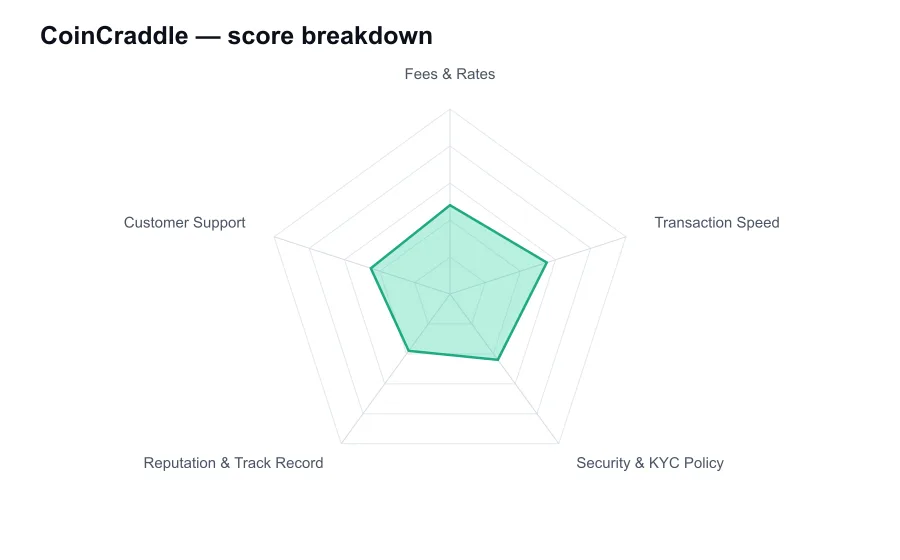
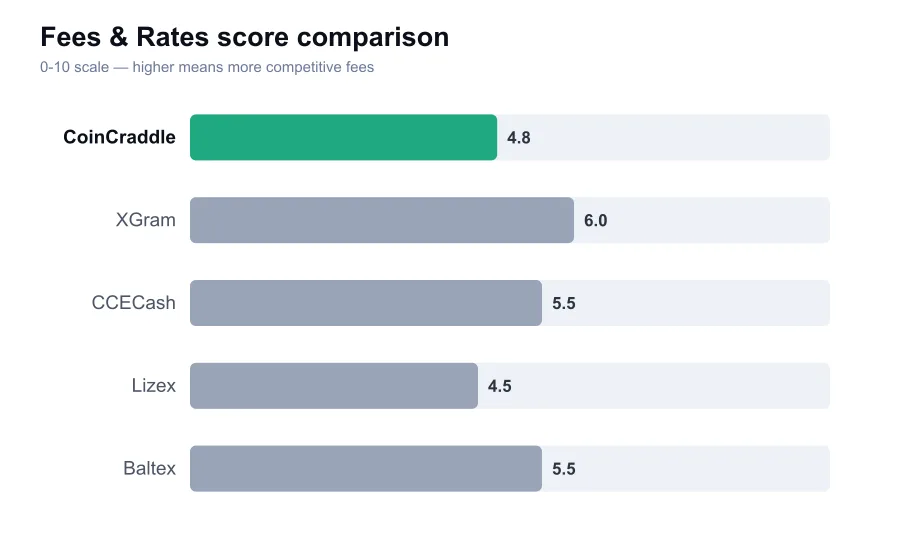
| Fees & Rates | 4.8 | Final quote needs close comparison due to limited fee clarity. |
| Transaction Speed | 5.5 | Blockchain confirmations set timing, with limited public evidence. |
| Security & KYC Policy | 4.4 | Temporary deposit custody and limited public transparency. |
| Reputation & Track Record | 3.8 | Does not have the visible record of established rivals. |
| Customer Support | 4.5 | Verify the support route before depositing any funds. |
| Fact | Value |
|---|---|
| Service type | Instant cryptocurrency exchange |
| Execution model | Deposit, conversion, and wallet payout |
| Account model | No conventional order-book account |
| Transaction risk | Deposit is irreversible after broadcast |
| Recommended use | Small test transactions only |
What is CoinCraddle?
How CoinCraddle Works
- Select the crypto pair and enter an amount
- Provide a compatible destination wallet address
- Review the displayed output and network details
- Send a test deposit to the generated address
- Keep the order details until the payout arrives
KYC
| Requirement | optional |
|---|---|
| Notes | A swap interface may not require routine registration, but users should not assume this prevents a compliance inquiry or transaction hold. |
How to Use CoinCraddle Safely
- Use only a small test amount on a first order
- Compare the final quote against established alternatives
- Confirm the token network and any memo requirement
- Save order details and the source transaction hash
- Avoid deadline-sensitive or high-value transfers
Review Summary
CoinCraddle is presented as an instant cryptocurrency exchange service, aimed at users who want to convert one crypto asset into another without using a traditional trading screen. It belongs to the same general category as ChangeNOW and ChangeHero, but it does not have their level of recognisable public history. That gap is the defining issue for a prospective customer, more important than the visual design of a swap form.
A service like CoinCraddle can be useful in theory. The user selects a pair, receives a deposit address, sends funds, and waits for the output to reach a supplied wallet. There is no need to leave a balance on the platform after the transaction, and that is appealing to self-custody users. The practical risk is that the provider has temporary control over the funds while the exchange is underway.
CoinCraddle should therefore be approached as an unproven intermediary, not as a place to consolidate holdings. A clean website, an attractive quote, or a claim of no registration cannot substitute for a long record of completed orders, transparent ownership, accessible legal terms, and independently visible customer-service performance. Those are the things that separate an established instant exchanger from a site that merely resembles one.
Fees are especially difficult to assess without a clear published pricing framework and a large body of independently comparable execution data. Instant exchangers often roll their fee, market spread, and network cost into the final amount displayed to the user. That is not inherently deceptive, but it means the quote must be compared directly with alternatives. With CoinCraddle, I would regard every price as a one-time offer that needs external checking.
A narrow difference between the quoted rate and a liquid market price may be perfectly reasonable after liquidity and blockchain costs. A large difference is a warning sign, particularly if the provider cannot explain it clearly. Users should compare the expected destination amount against a major exchange, a known instant-swap provider, and, where appropriate, a decentralized exchange. If CoinCraddle is not clearly better for a small test trade, there is no compelling reason to make it the first choice.
Transaction speed has the same caveat. No instant exchange can complete the source side until a blockchain transaction has received enough confirmations. Fast networks can make the experience feel nearly immediate, while Bitcoin or congested Ethereum transfers may take much longer. After that, CoinCraddle must source the asset and broadcast a payout. A customer should distinguish chain delay from provider delay, while still expecting clear status information from the service.
There is very little reason to take a provider's claim of rapid settlement on faith if it has not built a substantial public record. A reputable operator gives users an order identifier, explains required confirmations, shows transaction status, and provides a realistic route to contact support. Those basics are not luxuries. They are the evidence a user needs if the output fails to arrive or the amount differs from expectation.
The security question is more serious than the interface question. Instant exchangers are not usually custodial in the sense of hosting an account balance for months, but they do receive deposits during a conversion. That means a user is trusting the provider with an irreversible transaction. If the service has weak operational controls, poor liquidity management, inaccessible staff, or undisclosed screening rules, there is limited recourse after coins leave the source wallet.
CoinCraddle should not be assumed to have a routine no-KYC guarantee merely because a swap can start without creating an account. Compliance controls can exist behind a no-registration interface. A transaction may be delayed or questioned if automated systems flag the source address. Before sending funds, users should read the current terms and risk policy directly and decide whether they could comply with a document request if one occurred.
Its public reputation is not strong enough for a generous score. I do not see the lengthy, easily verifiable operating footprint that would let a reviewer confidently compare CoinCraddle with long-running names such as ChangeNOW, Changelly, or ChangeHero. That does not prove misconduct. It does mean the service has not earned the presumption of reliability that comes with years of public operations, widespread integrations, and a visible pattern of resolving difficult cases.
Support is where that lack of depth becomes expensive. A normal exchange needs no support at all, which can create a false impression that everything is fine. The test arrives with a delayed order, a wrong-network deposit, a missing memo, or a transaction selected for review. Before using CoinCraddle, locate its official support route, confirm that order tracking exists, and save all records. If those basics are unclear, stop before depositing.
I would be particularly cautious with token networks. Stablecoins exist across several chains, and the ticker alone is not enough. Sending USDT on the wrong network can create a recovery issue that a small provider may not have the tools or willingness to solve. The same applies to assets requiring a memo or destination tag. A cheap quote does not compensate for a preventable address or network error.
There is a narrow case for using CoinCraddle: a technically confident user making a small, non-urgent exchange after checking the current quote and support information. Even then, use a test amount first. Do not use it for a large purchase, a deadline-sensitive transfer, funds tied to a compliance concern, or anything that would cause serious harm if delayed. Better-known providers offer a more defensible risk trade.
My assessment is blunt. CoinCraddle may function as an instant swap option, but it has not established the public transparency or track record needed for a strong recommendation. The lack of a mature reputation is not a minor weakness, because instant swaps are irreversible once the deposit is sent. Until the service develops a deeper verifiable record, it should remain a low-value test-only option for users who understand the risks.
Pros & Cons
| Pros | Cons |
|---|---|
| Simple instant-swap model | — |
| No permanent exchange balance needed | — |
| Potentially useful for a small test conversion | — |
Frequently Asked Questions
Is CoinCraddle a trading exchange with an order book?
No. CoinCraddle is presented as an instant exchange service, where a user submits a conversion order rather than placing maker or taker orders on a visible order book.
Should I use CoinCraddle for a large transfer?
No. Its reputation score here is 3.8 out of 10 because its public operating record is limited compared with established instant-exchange providers.
Why should I send a test transaction first?
A test confirms the selected network, receiving address, timing, and support process before a larger amount is exposed to an irreversible deposit flow.
Can a swap take longer than expected?
Yes. Source-chain confirmations, congestion, token liquidity, payout processing, or a compliance review can delay an instant-exchange order.
What is the biggest network mistake to avoid?
Do not rely on the token ticker alone. Confirm the exact chain for assets such as USDT and USDC, and include a required memo or destination tag where applicable.
Should I expect a no-KYC guarantee?
No. Starting a swap without account registration does not guarantee that a provider will never ask questions. Read the current terms before sending funds.