| Best for | Focused on Monero-related swaps, Simple alternative to order-book trading, Useful niche for small XMR conversions |
|---|---|
| Not for | Limited independently verifiable reputation, Privacy-coin swaps can face compliance reviews, Quote quality is difficult to assess in advance, Not appropriate for urgent or large transfers |
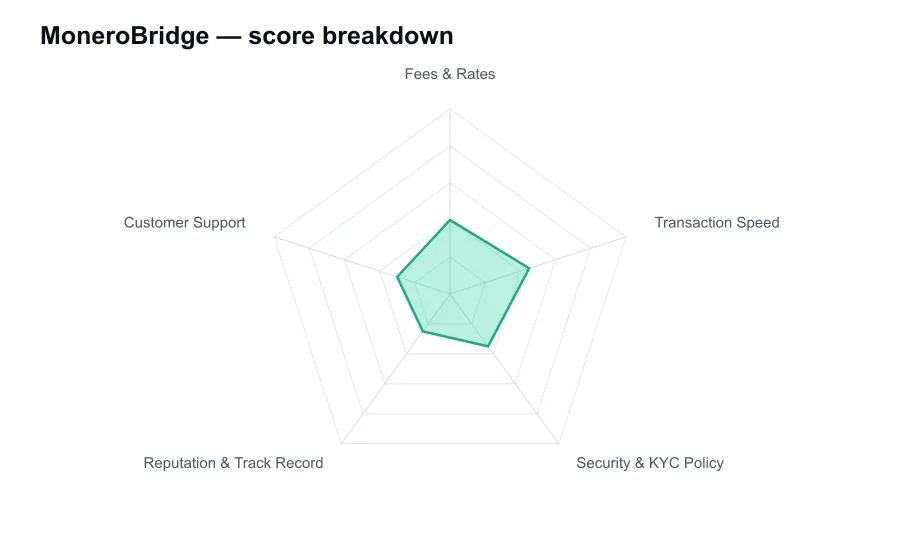
| Criterion | Score | Note |
|---|---|---|
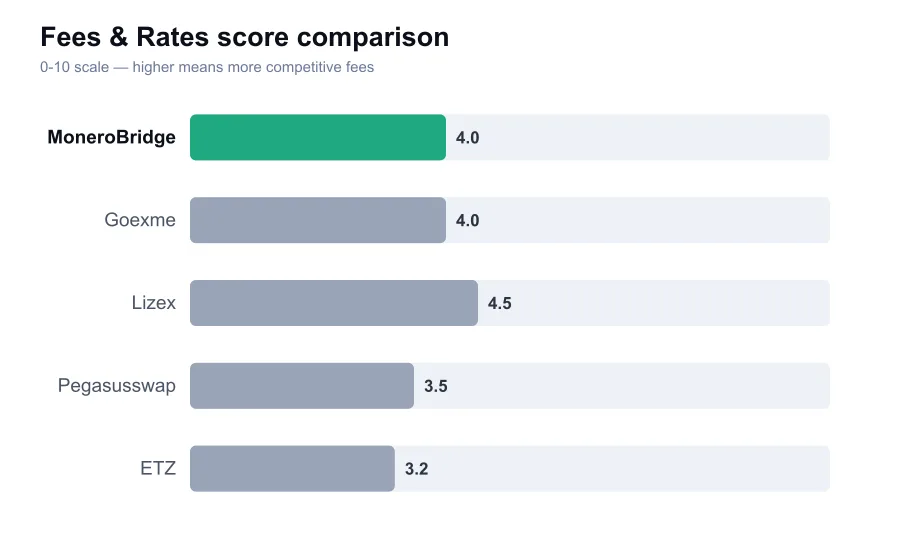
| Fees & Rates | 4.0 | XMR swap costs require quote-by-quote comparison |
| Transaction Speed | 4.5 | Privacy-coin routing and confirmations can add delays |
| Security & KYC Policy | 3.5 | Limited public transparency for a high-risk niche |
| Reputation & Track Record | 2.5 | Limited long-term independent reputation evidence |
| Customer Support | 3.0 | Few public support-resolution records to assess |
| Fact | Value |
|---|---|
| Service type | Instant cryptocurrency exchange |
| Primary niche | Monero and privacy-coin swaps |
| Trading interface | Quoted conversion flow |
| Public fee schedule | Not clearly established |
| Public track record | Limited independently visible history |
What is MoneroBridge?
How MoneroBridge Works
- Select the source asset and XMR or another destination asset
- Enter a compatible receiving wallet address
- Review the quoted amount and deposit instructions
- Send the exact asset on the requested network
- Wait for confirmations and the payout
KYC
| Requirement | optional |
|---|---|
| Notes | A registration-light flow should not be treated as a guarantee against identity review. Privacy-coin transactions may receive additional screening under a provider's compliance policy. |
Supported Assets
| Notable coins | Monero |
|---|
How to Use MoneroBridge Safely
- Use a fresh, self-controlled Monero wallet address
- Test the route with a small amount
- Check the net XMR output against other services
- Do not use the service for deadline-sensitive payments
- Keep transaction hashes and exchange details
Review Summary
MoneroBridge is positioned around a niche that many mainstream crypto services handle poorly, access to Monero and swaps involving privacy-focused assets. That focus gives it a clear audience. It also puts the service in a high-risk corner of the market, where liquidity is thinner, compliance scrutiny is heavier, and a provider's credibility matters far more than a clean exchange widget.
Monero remains difficult to buy, sell, and swap in some jurisdictions because large exchanges have delisted it or restricted privacy-coin trading. A service built around bridging users into and out of XMR can therefore be useful. The catch is that users should be especially careful with any provider asking them to transfer funds before they have a strong reason to trust the operator.
MoneroBridge does not have the broad, longstanding public reputation of exchanges such as Kraken, which has historically supported Monero in selected markets, or major instant-swap brands with extensive review histories. That does not prove wrongdoing. It does mean a customer has less outside evidence to rely on if a conversion stalls, a deposit is questioned, or support becomes unresponsive.
The central pricing question is the actual XMR amount received. Privacy-coin swaps are often more expensive than popular BTC or ETH conversions because available liquidity can be limited and because providers factor risk, routing costs, and operational overhead into the quote. A service may advertise a competitive rate while still delivering less than a larger rival after spread and network costs.
MoneroBridge should be assessed quote by quote, not through a presumed fee percentage. Compare the exact amount of XMR, BTC, or stablecoin expected from the same source amount across multiple services. Use a meaningful but small test size first. For a privacy coin, the receiving amount can vary enough that a vague claim of low fees tells you almost nothing.
Speed is similarly dependent on the route. Monero's own chain typically requires confirmation time before an exchange will treat a deposit as settled, and the other side of the swap may involve Bitcoin, Ethereum, or a stablecoin network with different confirmation rules. A completed swap can be reasonably quick, but privacy-coin liquidity and compliance screening create more opportunities for delay than a simple ETH to USDC conversion.
Users should not send a time-sensitive payment through MoneroBridge. If the recipient needs XMR at a precise time, acquire it in advance through a provider with a history you are comfortable trusting. Instant exchange services are transaction processors, not guaranteed settlement rails, and the risk becomes more painful when there is no well-documented support record.
The security issue here is not merely whether the site uses standard web encryption. It is the full operational chain. MoneroBridge must safely recognize an incoming deposit, obtain liquidity, send the correct asset to the correct address, manage wallet infrastructure, and handle exceptions. The public cannot directly audit most of those controls, so an operator's transparency and history become the practical substitute.
Any claim of no KYC should be read carefully. Privacy-oriented users often seek Monero because they value financial confidentiality, but that does not exempt an exchange from sanctions screening, fraud controls, or other compliance processes. A provider can ask for documentation after the deposit arrives if it considers a transaction risky. That possibility needs to be understood before you commit funds.
This creates a particularly awkward failure mode. A user seeking a low-friction XMR swap may find themselves asked for identification after sending Bitcoin or stablecoins, while the provider holds the transaction pending review. Even if the provider ultimately resolves the case fairly, that is not the service experience most privacy-minded users expect. Clear terms and a responsive support trail matter here more than usual.
MoneroBridge has limited public evidence on those points. I would not give it a strong security or reputation score simply because it operates in a privacy-focused niche. In crypto, privacy branding can attract users, but it should never replace due diligence about who controls the service, what policies apply to flagged transfers, and whether real users have documented successful resolutions.
Support needs to be judged through practical details. Can a user submit an exchange ID? Is there a clear path for an underpayment or wrong memo? Does the service explain minimum amounts and refund handling? Without a substantial history of publicly visible cases, a prospective customer cannot confidently answer those questions before a problem occurs.
There is one type of user for whom MoneroBridge may be tempting: an experienced Monero holder who understands wallet addresses, confirmation delays, and the need to test every unfamiliar swap service. Even that user should keep the amount modest and avoid complicated routes. Do not make an initial transaction your entire XMR purchase or your only way to exit a position.
For everyone else, the service asks for too much trust relative to the public evidence available. Monero already has technical and regulatory complications. Adding a lightly documented intermediary does not make the process safer or simpler. The sensible route is to prioritize a well-known venue that is legally available in your jurisdiction, or use an established swap provider after comparing current quotes.
My final take is that MoneroBridge addresses a real market need but has not earned a strong recommendation. Its XMR focus is useful in theory, yet the privacy-coin niche raises the cost of weak transparency. Treat it as an experimental small-swap option, not a dependable primary exchange. Anyone unwilling to risk a compliance hold or slow support response should look elsewhere.
Pros & Cons
| Pros | Cons |
|---|---|
| Focused on Monero-related swaps | — |
| Simple alternative to order-book trading | — |
| Useful niche for small XMR conversions | — |
Frequently Asked Questions
Is MoneroBridge a good place to make a large XMR purchase?
No. Its reputation score is 2.5 out of 10 because publicly verifiable operating history is limited. A small test transaction is much more prudent than a large first transfer.
Can a Monero swap take longer than a BTC or ETH swap?
Yes. XMR routes can involve Monero confirmations, liquidity sourcing, and additional compliance scrutiny. The speed score is 4.5 out of 10 for that reason.
Why do I need to compare the final XMR amount?
Privacy-coin liquidity can be thinner than liquidity for major assets. The effective cost may be embedded in the quote, so compare the net XMR received, not a claimed fee.
Does privacy-focused branding mean no KYC can ever be requested?
No. A provider can request documents after automated compliance screening, including after a deposit has been sent. Read the current terms before starting a swap.
Can I use MoneroBridge for an urgent payment?
It is not recommended. Confirmation timing, liquidity routing, and possible review delays make any lightly documented instant exchanger unsuitable for time-critical payments.