| Best for | Simple swap-focused concept, May offer access to specific routes, Could suit a very small test conversion |
|---|---|
| Not for | Minimal independently verifiable reputation, Unclear fee and liquidity transparency, Security model is not sufficiently documented, Not appropriate for large or urgent transactions |
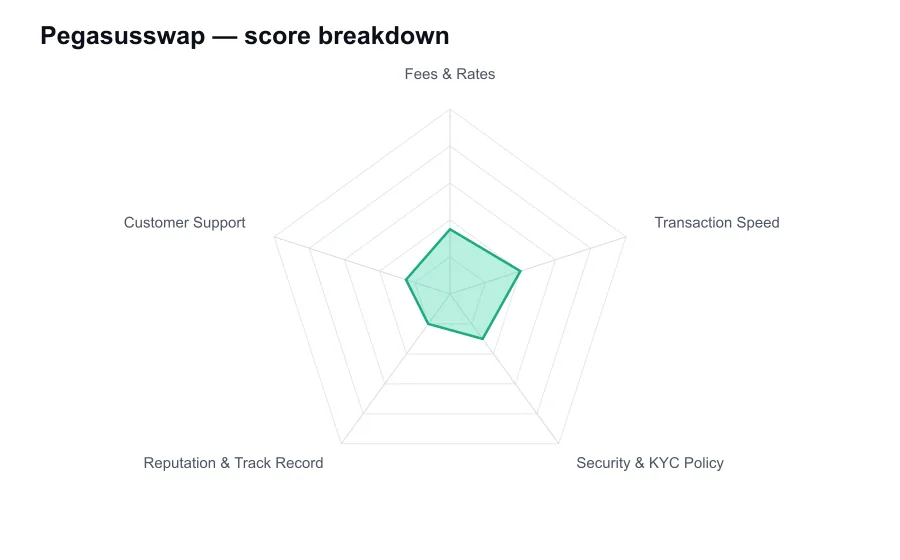
| Criterion | Score | Note |
|---|---|---|
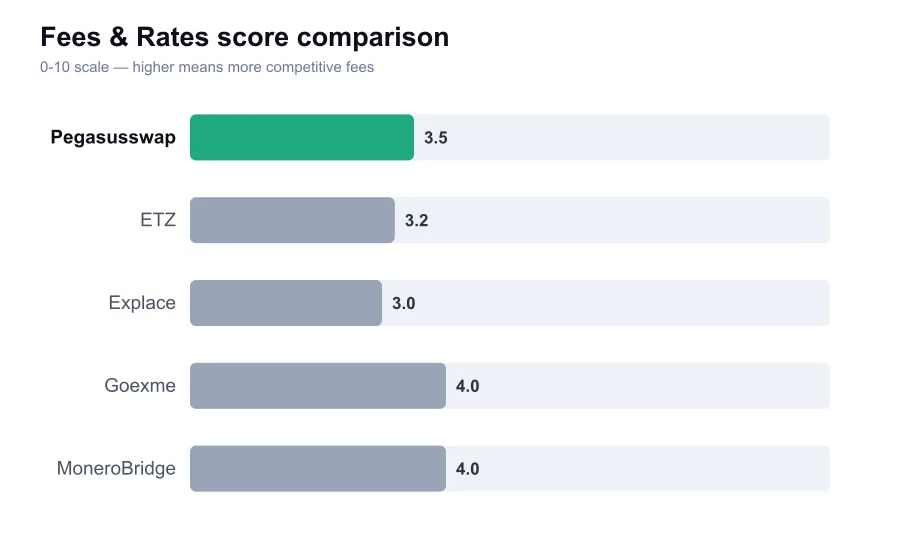
| Fees & Rates | 3.5 | Limited transparent evidence on spreads and fee structure |
| Transaction Speed | 4.0 | Settlement model and reliable timing are unclear |
| Security & KYC Policy | 3.0 | Public evidence of controls or audits is limited |
| Reputation & Track Record | 2.0 | Very limited independently visible track record |
| Customer Support | 2.5 | Support performance is difficult to verify publicly |
| Fact | Value |
|---|---|
| Service type | Swap-focused crypto provider |
| Trading interface | Quoted swap flow |
| Public fee schedule | Not clearly established |
| Security documentation | Limited independently verifiable detail |
| Public track record | Limited independently visible history |
What is Pegasusswap?
How Pegasusswap Works
- Select the intended crypto conversion
- Check whether the service requests a wallet approval or a deposit
- Review the quoted output and chosen network
- Send or approve only the amount needed
- Verify the payout in your receiving wallet
KYC
| Requirement | optional |
|---|---|
| Notes | Do not assume a simple swap flow rules out identity checks. If the service operates as a centralized exchange processor, it may apply transaction screening or request documents. |
How to Use Pegasusswap Safely
- Verify the genuine site through a trusted source
- Use a small test transaction first
- Never grant unlimited token approval to an unfamiliar contract
- Check the exact asset and network before sending
- Compare the final receive amount with established alternatives
- Keep transaction hashes and screenshots of the quote
Review Summary
Pegasusswap appears in the crypto market as a swap-focused provider rather than a full-service exchange. The name suggests a decentralized trading product, but users should not make assumptions from branding alone. A swap interface can be operated by a centralized company, can route through third-party liquidity, or can present itself as a decentralized service while retaining important points of control.
That distinction matters because Pegasusswap has a limited public profile compared with established decentralized exchanges such as Uniswap, PancakeSwap, Curve, or THORChain. Those protocols have visible smart contracts, extensive independent analysis, large user communities, and years of on-chain activity. Pegasusswap does not have comparable public evidence of scale or long-term resilience.
For a prospective user, the first question is basic: what exactly happens after funds are sent or approved? If Pegasusswap generates a deposit address and later pays out a different asset, it should be treated as an instant exchanger. If it asks a wallet to approve a smart contract, it should be treated as a smart-contract risk. The safe behavior differs, and the service needs to explain the flow clearly.
Publicly verifiable details about Pegasusswap's fees, liquidity sources, and operator history are limited. That makes it impossible to give the service a strong fee score. The price shown in a swap box may include a spread, routing cost, network charge, and partner markup. Without transparent documentation or a deep public record, users cannot easily identify which part of the quote is the provider's revenue.
This does not mean every quote will be poor. A small service can return a good price for a particular route. It does mean you should compare the net output with alternatives before authorizing a transaction. For token swaps, compare against a reputable aggregator or a well-known DEX. For cross-asset conversions, compare against an established instant exchange. The net amount received is the number that matters.
Speed is also uncertain. A real decentralized exchange can settle as soon as the relevant blockchain confirms the smart-contract transaction, while a centralized swap processor must also credit the deposit, source liquidity, and issue a payout. Pegasusswap's public materials do not provide enough independently verifiable operational detail to promise either model's typical timing.
I would not use it for urgent transfers. That is partly because blockchains themselves can be slow or congested, but mostly because small providers are hardest to evaluate when something leaves the normal path. An underpaid deposit, a token sent on the wrong network, a failed payout, or a suspicious-activity review can turn a supposedly quick swap into a support case.
Security is the biggest concern. If the product is custodial or semi-custodial, users need confidence that the operator can safeguard incoming assets and return them promptly. If it relies on smart contracts, users need confidence that those contracts are legitimate, correctly deployed, and audited. Neither confidence should be granted merely because a site uses familiar crypto terminology.
Wallet users should be especially wary of approvals. Never grant unlimited spending approval to an unfamiliar smart contract just because a swap page requests it. A malicious approval can allow a contract to drain the approved token later. If Pegasusswap uses a contract-based flow, inspect the contract address through a block explorer, use limited approvals where possible, and revoke unused permissions afterward.
If its flow is instead based on a deposit address, the danger shifts. You must verify the exact asset, chain, minimum amount, and payout address before sending. Exchange-style services can be unable to recover a token sent over the wrong network. With a provider of limited public reach, relying on discretionary manual recovery is a poor plan.
KYC policy is another point that should be treated as unknown unless the current terms spell it out. Many lightweight swap services let a transaction begin without account registration but reserve the right to request documents if a risk check triggers. Users who require a predictable identity-verification process should use a regulated platform that tells them the rules before money is sent.
Pegasusswap's reputation score is low because a meaningful independent track record is not readily visible. This is not a moral judgment about the team. It is a risk assessment. Reputation in crypto is built through years of uptime, transparent technical work, publicly documented support cases, security audits, and the ability to survive market stress. A scarce public record cannot substitute for those things.
Support is similarly hard to credit. Any provider can publish an email address or chat icon. The important test is whether a customer can obtain an order update, prove a deposit, understand a hold, and get a realistic answer about recovery or refund. Until there is ample public evidence of that process working consistently, customers should assume support may be limited.
A small test transaction is the only defensible way to approach Pegasusswap, and even that assumes you have independently verified that you are on the genuine domain. Search ads, cloned sites, and lookalike URLs are common in crypto. Bookmark the verified site after checking it from a trusted source, then test with an amount you could afford to lose.
Pegasusswap has not given me enough evidence to recommend it over better established alternatives. There is no compelling reason for a mainstream user to accept its higher transparency risk when mature instant exchangers and widely used DEXs already exist. A niche provider needs either an exceptional route, a dramatically better price, or unusually strong documentation to justify that risk. Pegasusswap does not clearly show one.
My final view is cautious to the point of discouragement for ordinary users. The service may be functional, but functionality is not the same as proven reliability. Keep any exposure tiny, avoid unlimited token approvals, and do not use it as a bridge for savings or business funds. Most users should choose a platform with a larger public record and clearer security model.
Pros & Cons
| Pros | Cons |
|---|---|
| Simple swap-focused concept | — |
| May offer access to specific routes | — |
| Could suit a very small test conversion | — |
Frequently Asked Questions
Is Pegasusswap a safe place for a large swap?
No. Its security score is 3 out of 10 and reputation score is 2 out of 10 because publicly verifiable evidence of controls and long-term operation is limited.
Should I approve unlimited token spending for Pegasusswap?
No. If the service uses wallet approvals, approve only the amount needed for the transaction where possible. Unlimited approvals can leave tokens exposed if a contract is malicious or compromised.
How can I tell whether Pegasusswap is using a smart contract or a deposit address?
A wallet approval and contract interaction indicates a smart-contract flow. A generated address that asks you to send coins before payout indicates an exchange-style deposit flow. Read the transaction screen carefully.
Why should I compare the final receive amount?
The service's pricing model is not clearly documented. The displayed output can include a spread, routing cost, network fee, or third-party liquidity markup, so compare net payout with alternatives.
Can a token sent on the wrong network be recovered?
Often not. Recovery depends on the receiving system and the provider's willingness and technical ability to assist. Confirm the exact asset and network before sending any deposit.