| Best for | May offer a simple exchange interface, Could suit a tiny test transaction after verification, Short brand name is easy to remember |
|---|---|
| Not for | Unclear public operating identity, No verifiable public fee schedule, Weak independently visible reputation, Support and security documentation are hard to confirm |
| Criterion | Score | Note |
|---|---|---|
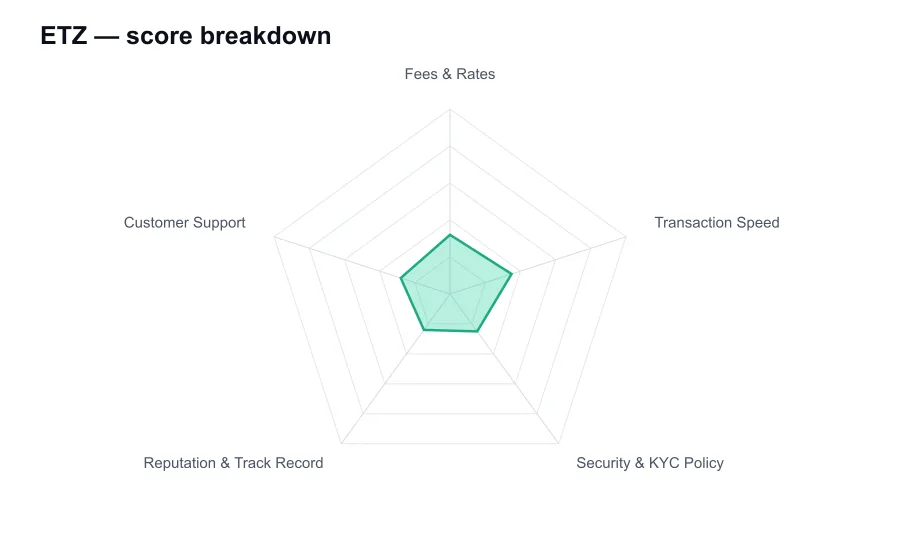
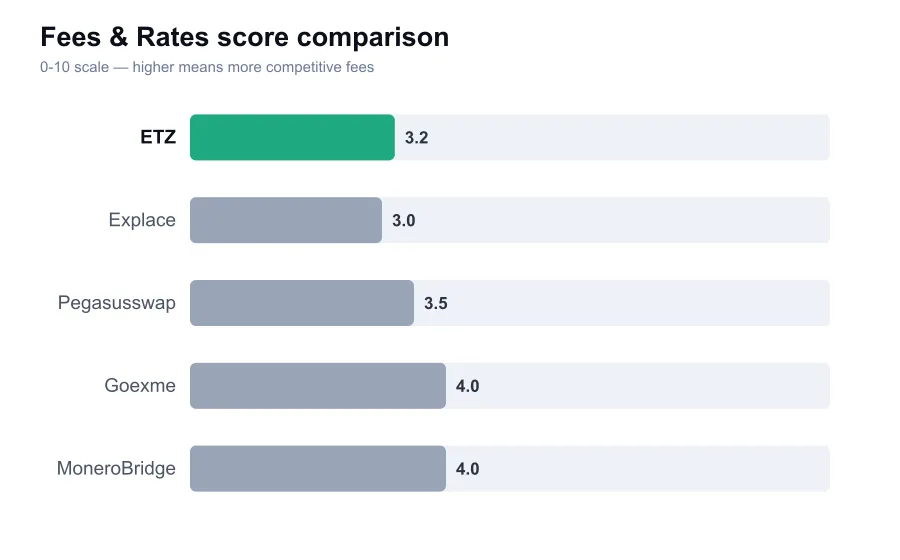
| Fees & Rates | 3.2 | No sufficiently clear, verifiable public fee schedule found. |
| Transaction Speed | 3.5 | Too little independent transaction evidence to rate highly. |
| Security & KYC Policy | 2.5 | Security, custody, and review practices are insufficiently documented. |
| Reputation & Track Record | 2.4 | Limited independently verifiable operating record under this name. |
| Customer Support | 2.8 | No mature, well-documented support record could be confirmed. |
| Fact | Value |
|---|---|
| Public fee schedule | Not independently verified |
| Ownership details | Not independently verified |
| KYC policy | Not independently verified |
| Support record | Not independently verified |
| Review assessment | Treat as unproven |
What is ETZ?
How ETZ Works
- Independently confirm the exact official ETZ domain and operator
- Read the terms and fee disclosures before creating an order
- Use only a small test amount if you decide to proceed
- Record the quote, address, order reference, and transaction hash
- Do not send additional funds while a first order remains unresolved
KYC
| Requirement | tiered |
|---|---|
| Notes | A reliable public KYC policy could not be confirmed. Assume identity verification may be requested after a risk review and do not send funds if that possibility is unacceptable. |
How to Use ETZ Safely
- Verify the official domain from independent sources
- Do not use sponsored links or chat messages
- Send a genuinely small test transaction first
- Save every quote and blockchain transaction hash
- Avoid using funds needed for time-sensitive payments
Review Summary
ETZ is one of the harder names to assess in crypto because the branding is short, generic, and poorly differentiated in public search results. A three-letter exchange name creates obvious problems for prospective users. It is easy to confuse with unrelated projects, tokens, businesses, and domains. That alone does not prove misconduct, but it does mean a reviewer should demand more evidence than a polished swap page and a few favorable comments before recommending it for a serious transfer.
I have not found a sufficiently clear public record tying the ETZ name to a widely established, independently verifiable crypto exchange operation. There is no strong basis to place it beside long-running instant exchangers such as ChangeNOW, FixedFloat, EasyBit, or Exolix. That lack of clarity is the central issue. A crypto service asking users to send irreversible assets needs a clear legal identity, stable official domain, public terms, support contacts, and a transaction record that can be checked.
For this reason, ETZ should not be judged by attractive advertised rates alone. Unknown or lightly documented exchange sites often display rates that look superior to large competitors because the user sees an estimate before the difficult part begins. The relevant test is whether the service delivers the quoted asset promptly, explains its spread and network charges, and has a reliable way to resolve failed orders. Without clear published fee documentation, I cannot award ETZ a strong fees score.
A low visible fee can be more dangerous than a plainly higher one if the service does not explain how it earns money. Instant exchanges can make revenue through a stated service fee, a rate spread, partner-liquidity pricing, or withdrawal and network charges. None of these methods is inherently improper. The problem begins when the customer cannot determine the actual all-in price until after funds have been sent. ETZ does not provide enough independently verifiable public information for me to call its pricing transparent.
Speed claims deserve similar caution. Almost any exchange can say that a swap takes minutes. A transaction on a fast chain may indeed settle quickly, while Bitcoin and Ethereum deposits can take longer due to confirmation requirements and network activity. Yet speed is not merely a blockchain issue. It also depends on whether the service has available liquidity, whether the deposit is credited promptly, and whether a manual review interrupts the order. ETZ has not built enough visible track record for its speed claims to carry much weight.
The most responsible way to approach an unproven provider is to assume that customer recourse will be limited. Crypto transactions are final. If a service is slow, changes its terms after receiving funds, or becomes unreachable, a bank cannot reverse the transfer for you. For a small experimental swap, a user may choose to accept that risk. For savings, a business payment, or a six-figure conversion, it is an unacceptable trade-off when established alternatives have clearer histories and documented support channels.
Security is where ETZ falls furthest behind better-known competitors. I cannot confidently verify a robust public explanation of its operational security, custody model, compliance process, or incident response. A service can be non-custodial in marketing language while still controlling the conversion path and holding funds during execution. That is why users should ask direct questions: Who operates the site? Is there a public terms page? What happens if an order is held? Is the deposit address tied to a secure, auditable process?
KYC policy is also not something to infer from the absence of a registration screen. Many instant exchange services allow a standard swap without identity documents but reserve the right to request them after a risk alert. If ETZ operates that way, it should say so plainly before a customer deposits funds. If it does not, that too should be documented. Ambiguity around identity checks creates a bad outcome, the customer can learn about a verification request only after the funds are already beyond their control.
A solid crypto provider earns reputation through years of ordinary, boring competence. It publishes working contact paths, handles wallet maintenance notices, responds to transaction disputes, and does not disappear whenever a user asks a difficult question. ETZ has not accumulated enough visible evidence of that kind. The absence of a prominent public reputation is not a reason to call it fraudulent. It is a reason to treat it as unproven, and those are very different statements.
Support is particularly important for an exchange that may be unfamiliar to a user. A useful support operation identifies the exact order, confirms the deposit status, explains required confirmations, and gives a clear answer about what is blocking the payout. Generic chat replies are not enough. I could not verify a mature, publicly documented support system for ETZ that would justify confidence during a high-stress delayed transaction. That is a major weakness for any service handling irreversible transfers.
There is another practical concern with an ambiguous brand name. Phishing risk becomes worse. Users may see similarly named domains, social accounts, token pages, or messaging profiles and assume they are connected. A legitimate exchange should make its official web address, social channels, legal documents, and customer contact routes easy to distinguish. If you cannot independently establish those basics before depositing, stop there. No appealing rate compensates for uncertainty about whether you are even on the correct site.
ETZ may work for users who have already verified the exact entity through a trusted referral and are testing a very small amount. Even then, the test should be genuinely small and should use a widely supported asset rather than an obscure token. Keep screenshots of the quote, the destination address, the transaction ID, and all support messages. Do not send funds from a wallet or account that depends on rapid settlement.
There are much better choices for people who need confidence. Established instant exchangers publish more about their operating model. Regulated centralized exchanges provide stronger identity, account controls, and fiat rails. Decentralized exchanges can offer direct on-chain execution, though they introduce smart-contract and wallet risks of their own. ETZ currently gives too little verifiable information to justify choosing it over those options for more than a cautious experiment.
My assessment is deliberately severe because the burden is on a financial service to establish trust, not on the customer to fill in missing facts. ETZ may be a functioning service, but its public footprint does not support a confident recommendation. Until its ownership, fee model, support path, security practices, and operational record can be independently verified, I would keep it off any shortlist for important transactions. In crypto, uncertainty itself is a cost, and here it is the dominant one.
Pros & Cons
| Pros | Cons |
|---|---|
| May offer a simple exchange interface | — |
| Could suit a tiny test transaction after verification | — |
| Short brand name is easy to remember | — |
Frequently Asked Questions
Is ETZ a well-established crypto exchange?
I could not verify a substantial, independently documented operating history for a crypto exchange under the ETZ name. Treat it as an unproven provider rather than as a peer of major exchanges.
What does ETZ charge for swaps?
A clear, verifiable public fee schedule was not available for this review. Do not rely on a displayed estimate without checking the final amount, network fee treatment, and exchange terms.
Does ETZ require KYC?
Its KYC policy could not be verified with confidence. Do not assume that a service without visible registration cannot request identity documents after a transaction is flagged.
How can I verify that an ETZ website is official?
Confirm the domain through a trustworthy primary source, then check for matching legal terms, support contacts, and established social profiles. Do not trust messaging links, search advertisements, or lookalike domains.
Should I test ETZ before sending a large amount?
Yes. If you use it at all, send only a small disposable test amount first. Save the quoted rate, transaction ID, deposit address, and any support correspondence.
What should I do if an ETZ transaction is delayed?
Keep the blockchain transaction hash and the order details, then contact the verified support channel. If you cannot confirm a legitimate support route, do not send additional funds.