| Best for | Simple crypto-to-crypto conversion flow, No order-book account needed for routine swaps, Direct payout to a user-controlled wallet, Potentially fast for liquid pairs |
|---|---|
| Not for | Limited public reputation and security disclosure, Quote spread is not fully transparent, Not suitable for large first-time transactions, Support record is difficult to assess independently |
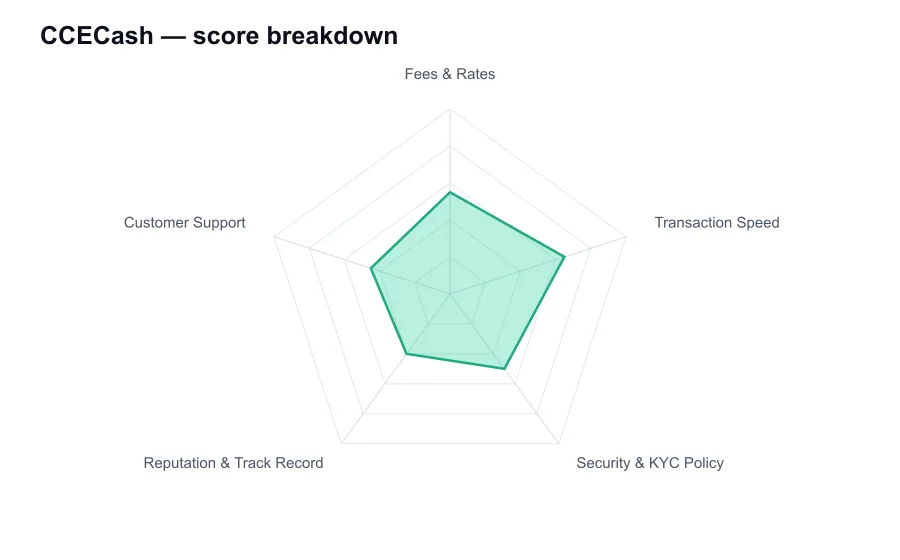
| Criterion | Score | Note |
|---|---|---|
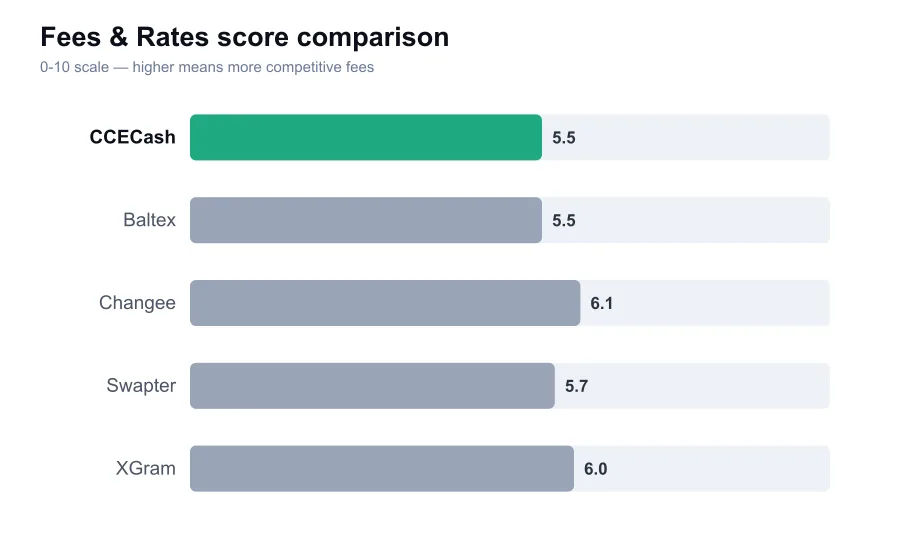
| Fees & Rates | 5.5 | The actual cost is embedded in each exchange quote. |
| Transaction Speed | 6.5 | Normal swaps can be quick after network confirmation. |
| Security & KYC Policy | 5.0 | Limited public disclosure on custody and security controls. |
| Reputation & Track Record | 4.0 | Limited independent track record beside established services. |
| Customer Support | 4.5 | Basic order assistance, with little evidence for complex cases. |
What is CCECash?
How CCECash Works
- Select the cryptocurrency pair and desired amount
- Enter a receiving wallet address on the chosen network
- Review the quote and generated order instructions
- Send the exact deposit amount to the displayed address
- Wait for confirmation and delivery to your wallet
KYC
| Requirement | tiered |
|---|---|
| Notes | Orders can use a low-registration flow, but AML and blockchain-screening checks can result in requests for identity or source-of-funds information. |
Supported Assets
| Notable coins | Bitcoin, Ethereum, Tether, USD Coin, Litecoin |
|---|
How to Use CCECash Safely
- Use a small test order before a larger conversion
- Compare the final quote with an established alternative
- Verify the chain for every stablecoin transaction
- Save the order page and deposit transaction hash
- Withdraw the payout to a wallet you control
Review Summary
CCECash is an instant cryptocurrency exchange service aimed at people who want to convert one coin into another without maintaining a full trading account. Its model is familiar: select a pair, enter a destination address, send the deposit, and receive the converted asset. That sounds simple because it is simple, at least for a successful routine order. The hard part is deciding whether a little-known intermediary deserves your trust during the period it holds the funds.
The site is positioned around quick, low-friction swaps rather than advanced exchange trading. There are no meaningful reasons to choose CCECash for charting, derivatives, or deep order-book execution. Its appeal is mainly convenience and the possibility of exchanging assets with less account friction than at a large centralised exchange. That can be useful for a self-custody user, but it also leaves the customer dependent on a quoted price and an operator with a relatively limited public profile.
CCECash should not be confused with a decentralised exchange. The customer may send directly from a personal wallet and receive directly into another wallet, but the platform still coordinates the conversion and temporarily handles the deposited funds. It is therefore a custodial counterparty during the swap. This distinction matters. A non-custodial interface is not the same thing as a trustless transaction, especially if a trade is delayed or selected for compliance review.
The fee picture is quote-based. CCECash does not offer the clean maker and taker schedule you would expect from a conventional trading venue. Its margin, liquidity costs, and network expenses are reflected in the offered exchange amount. That is not automatically unfair, and some orders can be competitively priced. Still, a customer cannot judge cost by reading a single advertised percentage. The only meaningful comparison is the final amount received for the exact pair, amount, and network.
This pricing structure is acceptable for a small convenience swap. It becomes much less attractive for a large order, because even a modest hidden spread can exceed a transparent exchange trading fee by a wide margin. Check CCECash against Alfacash, ChangeNOW, FixedFloat where appropriate, and a major exchange withdrawal route. If its final quote wins after network fees, fine. If it does not, there is no special feature here compelling enough to justify paying a premium.
Speed can be good on normal orders. Fast networks and liquid pairs may settle shortly after the required deposit confirmation. Bitcoin and Ethereum deposits take longer when the sending transaction has a low fee or the network is busy. CCECash cannot turn a slow Bitcoin confirmation into an instant payment, so users should set reasonable expectations. A transaction that remains pending before confirmation is usually a network matter, while one pending long after confirmation calls for an order-status check and support contact.
The reputation issue is harder to dismiss. CCECash has a much lighter independent record than established exchanges and long-running instant-swap brands. There is little public evidence that lets a customer confidently assess how it handles complex incidents, large orders, or prolonged compliance disputes. A clean-looking website and a successful first swap are not enough. In crypto, reputation is built by years of visible problem resolution, not by a polished rate calculator.
For that reason, I would never make CCECash the first destination for a large balance. Start with an amount small enough that a delay would be irritating rather than financially damaging. Confirm that the payout reaches the intended wallet, then decide whether there is any reason to return. This is not paranoia. It is the normal standard I apply to any lesser-known intermediary that receives assets before delivering the other side of a trade.
KYC policy should also be understood as conditional. A service may permit a straightforward order without account creation, but that does not mean every transaction is anonymous or exempt from review. Blockchain analytics, sanctions screening, source-of-funds queries, and payment-provider rules can lead to a document request. If CCECash pauses a transaction, the user needs a clear support route and a realistic expectation that compliance cases may take longer than ordinary swaps.
The service has limited public security transparency compared with a licensed exchange that publishes security controls, custody arrangements, audit information, and formal incident disclosures. There is no reason to assume a breach, but there is also no basis for assigning it the confidence level of Kraken or Coinbase. The sensible response is to limit exposure. Use a newly checked receiving address, avoid sending from a source that may confuse a compliance review, and do not leave any balance behind after the order settles.
Users should pay extra attention to network selections. Stablecoins can exist on Ethereum, Tron, BNB Smart Chain, Polygon, and other networks. A provider may support the asset name while supporting only certain chain routes. Sending USDT to an address on an unsupported network can turn an easy exchange into an expensive recovery request, if recovery is possible at all. CCECash users should inspect the order page, not rely on the ticker alone.
Support is likely sufficient for simple order questions but is not a reason to take outsized risk. Smaller exchanges can answer basic requests quickly, yet customers need more than a contact form when funds are locked in a manual review. I would save screenshots of the quote and status page before contacting support, then provide the transaction hash in the first message. Repeated messages without the factual details rarely speed up resolution.
CCECash has a legitimate role as a tactical conversion tool for users who have compared its quote and understand the risks of using an instant exchanger. It does not have enough demonstrated reputation or disclosure for me to call it a default choice. The crypto market has plenty of lookalike services, and the burden is on CCECash to distinguish itself through consistent execution and transparent handling of exceptions.
My final view is firm. CCECash may be convenient for a small swap, but convenience is its main selling point and that alone is not a strong basis for trust. Its quote should be checked against better-known alternatives every time. Keep orders modest, preserve records, and use self-custody before and after the exchange. Users needing strong consumer protections, a deep trading venue, or proven high-value support should go elsewhere.
Pros & Cons
| Pros | Cons |
|---|---|
| Simple crypto-to-crypto conversion flow | — |
| No order-book account needed for routine swaps | — |
| Direct payout to a user-controlled wallet | — |
| Potentially fast for liquid pairs | — |
Frequently Asked Questions
Is CCECash a decentralised exchange?
No. CCECash is an instant exchange intermediary. It may pay directly to your wallet, but it temporarily receives and processes the deposited cryptocurrency during a swap.
How are CCECash fees charged?
Costs are mainly reflected in the exchange quote rather than a visible maker and taker fee schedule. Compare the exact final payout with another provider before depositing.
Can CCECash ask for identity documents?
Yes. A low-registration swap does not rule out AML checks. A transaction that triggers screening can require identity or source-of-funds information before it is completed.
Why is my order still waiting after I sent crypto?
First confirm that the deposit has enough blockchain confirmations. If it is confirmed but remains pending, save the order reference and transaction hash before contacting support.
Can I leave a balance on CCECash?
It is better not to. Instant exchangers are designed for individual conversions, not long-term custody. Receive the payout into a wallet you control.
Do stablecoin networks matter for a CCECash swap?
Yes. USDT and USDC exist on multiple networks. Confirm the selected network on both the deposit and receiving side before sending any funds.